Coffee Roast Levels: Chart & Complete Guide
What are the different coffee roast levels? From pale green seeds at room temperature to nearly black, oil-slick Italian roast around 473°F, every stage changes color, aroma, acidity, and how much origin flavor survives in the cup. Roasting is not one switch. It is a ladder of named styles, each with a temperature band and a personality in the mug.
You have probably bought medium roast a hundred times without knowing what that actually means on the roaster’s drum. Or why dark roast tastes stronger even when it often has less caffeine by weight than a light roast.

Here’s the deal…
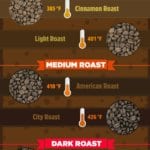
We built the chart above to show the minimum roast styles every coffee lover should recognize: the full rung-by-rung path from unroasted green to the darkest commercial roasts. The title is a pun on purpose. During roasting, beans literally crack: first crack near light roast, second crack as you push into dark territory.
We will walk every stage on that chart, explain what happens inside the bean, and drop one memorable story or fact for each named roast so you can order, blend, and brew with real confidence.
How to Read Our Coffee Roast Levels Chart
So what do those Fahrenheit numbers on the infographic actually measure?
They are roast-stage reference temperatures, not a promise that your home oven dial will match what happens inside a commercial drum roaster. Bean density, batch size, airflow, and how fast the roaster heats all shift timing. Two roasters can hit City Roast at slightly different clock times and still land in the same color family.
What matters more than a single number:
- Color and surface oil: matte tan at light levels, growing sheen by Vienna and French.
- First crack: a popcorn-like sound when moisture and pressure escape; light roasts live around here.
- Second crack: a finer, rice-krispie crackle; dark roasts push into and past this zone.
- Development time: how long the bean cooks after first crack shapes sweetness vs bitterness.
Why does that matter?
Because roast names are a shared language between roasters and drinkers. Learn the ladder once, and bag labels stop feeling like marketing fiction.
Unroasted Stages: Green Beans and Drying
Before cinnamon brown or espresso black, every coffee bean is a dense, grassy-smelling seed. The first two steps on our chart are not “drinkable roasts” yet. They are the foundation everything else is built on.
Green Beans (72°F)
What you see: Pale greenish-grey beans, hard and matte. No coffee aroma you would recognize.
What is happening: This is coffee at rest: harvested, processed, dried at origin, and stored. No Maillard reaction yet. No caramelization. Just raw potential.
Story worth knowing: Green coffee is famously stable. Stored cool and dry, it can sit for months or longer while traders ship it worldwide, which is why coffee became a global commodity long before anyone had a fancy roastery on Main Street. The clock on peak flavor starts ticking after you apply heat. If you have ever wondered why “unroasted” is its own hobby, that shelf life is a big part of the answer. (We keep a full buyer angle on our unroasted coffee beans page.)
Drying Phase (329°F)
What you see: Beans turn yellowish-cream as surface moisture cooks off.
What is happening: Internal water steams toward the surface. The bean is warming through, but roast flavors we associate with “coffee” have not developed yet. Chaff, the papery skin on the bean, often starts to flake.
Story worth knowing: Skip or rush drying and the rest of the roast fights you. Roasters sometimes call this the “grass phase” because the smell can resemble hay or sweet grain. Ethiopian and other high-elevation dense beans can linger here longer than softer low-grown lots. Patience at 329°F is boring to watch. It is not boring to taste in the cup later.
Light Roast: Where Origin Flavor Shines
Light roasts preserve more of what the soil, altitude, and variety gave the bean. Acidity reads brighter. Floral and fruit notes survive. Body is usually lighter.
If your goal is to taste where the coffee grew, this is your neighborhood. For bean picks in this range, see our best light roast coffee beans guide.
Cinnamon Roast (385°F)
What you see: Light toasted brown, the color of cinnamon bark, not the spice mixed in.
What is happening: Early Maillard reactions are underway. You are typically approaching or just before first crack. Very little surface oil.
Story worth knowing: “Cinnamon” confuses almost everyone the first time they hear it. No cassia in the drum. Early American roasters named roasts by color, and this one matched the pantry spice. In New England you will sometimes hear “New England roast” used for similarly pale cups. Specialty cuppers may roast even lighter for scoring, but cinnamon is about as light as most commercial drinkers willingly go.
Light Roast (401°F)
What you see: A slightly deeper, more even light brown than cinnamon, still dry on the surface.
What is happening: First crack territory. Sugars begin caramelizing in earnest. Chlorogenic acids are breaking down, which is why bitterness has not taken over yet.
Story worth knowing: Nordic countries helped re-popularize lighter roasting in the specialty era. The logic is simple: if you paid for a Kenyan bean with blackcurrant notes or a Ethiopian with jasmine, burning those away defeats the point. World Coffee Research and competition cupping culture both lean light for the same reason: origin transparency. A 401°F-style light roast is often where “I taste the blueberry” comments come from, not from flavored syrup.
Medium Roast: The American Sweet Spot
Medium roasts balance origin character with roast sweetness. Acidity softens. Chocolate and nut tones rise. This is the profile behind a lot of “house blend” bags at the grocery store.
Our best medium roast coffee beans roundup digs into bags worth trying once you know the labels.
American Roast (410°F)
What you see: Classic medium brown: what many U.S. drinkers picture when someone says “regular coffee.”
What is happening: First crack is complete or winding down. The bean has fully expanded. Sweetness and body are climbing without heavy smoke or carbon notes.
Story worth knowing: The name is patriotic marketing from early 20th-century U.S. roasters who wanted a national baseline: not as pale as East Coast cinnamon, not as sooty as European dark styles flooding immigrant cafes. “American roast” became shorthand for the middle of the road: the roast your diner mug aspired to before third-wave shops put origin stories on the chalkboard.
City Roast (426°F)
What you see: Darker medium brown, still mostly matte.
What is happening: Late first-crack / early post-crack development. More caramelization, slightly lower perceived acidity than American.
Story worth knowing: “City” versus “Full City” is old roaster slang from when urban roasteries pushed a hair darker than rural or “country” styles. In modern specialty shops, City is often the default for single-origin pour-over: enough development for sweetness, not enough char to flatten the farm’s fingerprint. If you have had a carefully made V60 that tasted like milk chocolate and orange zest, odds are good the roaster was thinking “City,” not “French.”
Dark Roast: Smoke, Oil, and Bold Cups
Dark roasts trade origin nuance for body, bitterness, and roast-driven flavor: smoky, bittersweet, sometimes carbony. Surface oils become visible. Acidity drops sharply.
Dark roast fans should bookmark our best dark roast coffee beans page. French roast lovers have a dedicated short list on four of the best French roast coffee beans anywhere.
Full City Roast (437°F)
What you see: Rich dark brown; oils may appear as tiny spots but the bean is not shiny yet.
What is happening: You are at the doorway of second crack. Roast flavor competes openly with origin flavor.
Story worth knowing: Full City is the compromise roast for espresso blends worldwide. Italian-style espresso culture often goes darker, but many third-wave espresso recipes stop near Full City so chocolate and caramel survive the 9-bar extraction without turning ashy. Think of it as the roast equivalent of a well-seared steak: deep flavor, not charcoal.
Vienna Roast (446°F)
What you see: Very dark brown with a slight sheen; oils migrating to the surface.
What is happening: Second crack is underway. More cellulose breakdown, more smoke character in the aroma.
Story worth knowing: The name nods to Vienna’s 17th-century coffeehouse boom, when coffee crossed from medicinal curiosity to social institution across Europe. Viennese coffee house culture gave us the melange and a taste for roasts darker than Nordic light but not quite French carbon. Today “Vienna” on a bag signals “serious dark, still drinkable black if you like intensity.”
French Roast (464°F)
What you see: Deep chocolate-to-black brown, noticeably oily and shiny.
What is happening: Well into second crack. Many origin-specific flavors are roasted away; what remains is bold, smoky, bittersweet cup character.
Story worth knowing: Despite the Parisian name, “French roast” is largely American roast vocabulary, a marketing label for a very dark profile that took off in U.S. supermarkets in the late 20th century. Starbucks’ early identity leaned into extra-dark roasts that overlapped this zone. Fun caffeine wrinkle: darker beans lose mass as they roast, so if you measure coffee by scoop instead of weight, a “stronger tasting” French cup can actually deliver slightly less caffeine than a light roast scoop. Taste and caffeine are not the same dial.
Italian Roast (473°F)
What you see: Nearly black beans, heavy oil, glossy under light.
What is happening: Late second crack / edge of scorching. Maximum roast flavor, minimum origin detail. Lowest acidity of the chart.
Story worth knowing: Walk into a traditional Italian bar and order an espresso. The roast in the hopper is often in Italian territory, partly because very dark roasts cut through steamed milk in cappuccinos and caffè lattes, and partly because decades of commodity blending rewarded a profile that tasted consistent even when the underlying lots shifted. Purists argue modern specialty Italy is lighter than the stereotype. The infographic’s 473°F Italian stage still defines what many non-Italians think espresso tastes like: short, bitter-sweet, smoky.
Coffee Roast Levels Compared: Quick Reference
| Category | Roast Name | Reference Temp (°F) | In the Cup (Typical) |
|---|---|---|---|
| Unroasted | Green Beans | 72 | Not brewed as coffee |
| Unroasted | Drying | 329 | Transition phase |
| Light | Cinnamon | 385 | Bright, grassy-to-sweet, high acidity |
| Light | Light Roast | 401 | Fruit, floral, origin-forward |
| Medium | American | 410 | Balanced, nutty, everyday mug |
| Medium | City | 426 | Sweeter, chocolate notes building |
| Dark | Full City | 437 | Caramel, bittersweet, espresso-friendly |
| Dark | Vienna | 446 | Smoky, oily, low acidity |
| Dark | French | 464 | Bold, bitter-sweet, heavy body |
| Dark | Italian | 473 | Darkest, carbony, espresso stereotype |
Which Roast Should You Buy?
There is no crown roast, only the right roast for your brew method and taste.
- Pour-over or drip, origin curious? Cinnamon to City (385–426°F).
- Diner mug, cream and sugar? American to Full City (410–437°F).
- Espresso with milk? Full City to Italian (437–473°F).
- Cold brew? Medium to dark: many recipes use City through French for lower acidity and chocolate depth.
But here’s the catch: two bags labeled “medium” from different roasters can taste nothing alike. Use the color on the chart, ask your roaster when you can, and adjust grind and dose before you blame the origin.
Related Articles
If you found any of these categories of roasting interesting, check out some of our choices for each below:
- Best Light Roast Coffee Beans
- Best Medium Roast Coffee Beans
- Best Dark Roast Coffee Beans
- Best French Roast Coffee Beans
FAQ
Does dark roast have more caffeine?
Usually not by weight. Roasting burns off some caffeine, but the difference is modest. The real jolt gap shows up when you scoop by volume: dark beans are less dense, so your scoop may hold slightly less caffeine than the same scoop of light roast.
What is first crack vs second crack?
First crack sounds like popcorn: moisture and CO₂ escaping as the bean structure opens. It marks the doorway to light roast. Second crack is quieter and sharper; oils push to the surface and dark roast flavors dominate. Our infographic title, “Taking a Crack at It,” is a nod to both sounds.
Can I roast at home to these temperatures?
Yes, with a dedicated home roaster, a heat gun setup, or even a modified popcorn popper, though exact °F readouts vary by gear. Many home roasters go by sound, color, and smell more than digital numbers. Our portable coffee roaster guide covers entry hardware if you want to climb the ladder yourself.
Why do roast names sound European?
American roasters adopted City, Vienna, French, and Italian labels in the 20th century to evoke coffee cultures associated with certain cup styles. The names describe color curves, not passports.
Bottom Line
Coffee roasting is a controlled climb from green seed to crackling, caramelizing bean. The infographic above is the map: ten named stages, four color families, temperatures from 72°F to 473°F. Light roasts tell origin stories. Medium roasts split the difference. Dark roasts bring smoke, oil, and the espresso profile much of the world grew up on.
Next time you stare at a wall of bags, pick one stage on the chart and brew with intention. That is how medium roast stops being guesswork, and starts tasting like a choice you actually made.
Infographic: Coffee Bean Roasting: Taking a Crack at It! (The Coffee Bean Menu). Embed and share with attribution welcome.