What Is Mushroom Coffee? A Coffee Bean Menu Guide
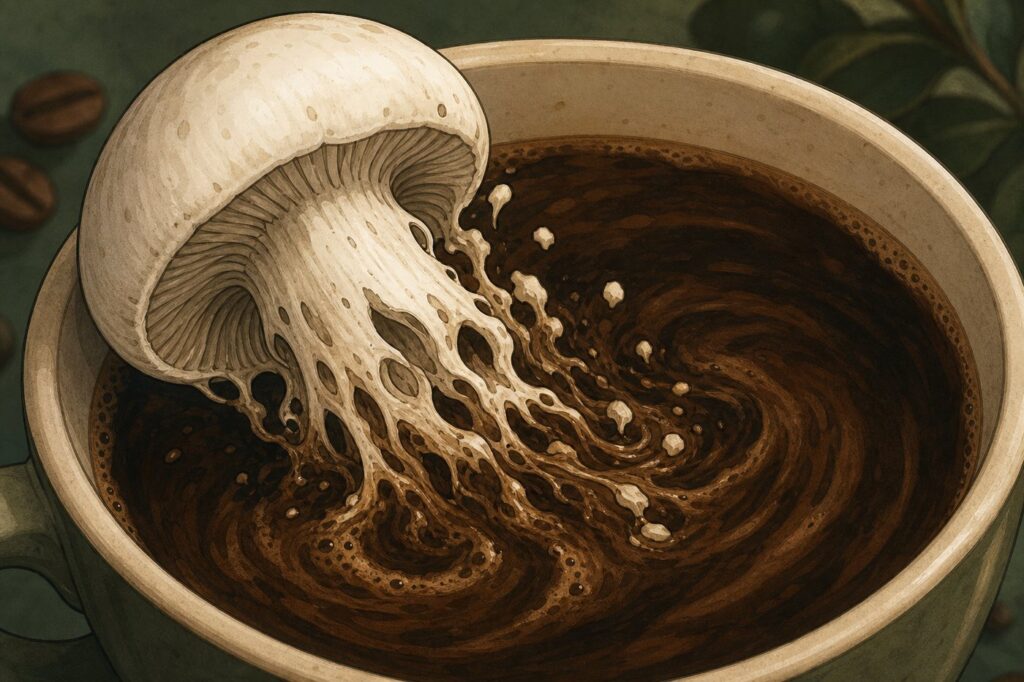
What is mushroom coffee? It’s regular coffee — ground or instant — blended with powdered extracts from medicinal mushrooms like Lion’s Mane, Chaga, Reishi, and Cordyceps. It’s not psychedelic. It usually tastes like coffee, and many blends have less caffeine than a standard drip cup.
You’ve seen mushroom coffee. It sounds ridiculous — fungi in your morning cup. And yet it’s everywhere now.
Do You Want The BEST #1 Mushroom Coffee?
YES - GET IT NOW
Here’s the deal: mushroom coffee didn’t start on TikTok. It started when people had no coffee at all. The full story ends with goats — the same legend we tell elsewhere on The Coffee Bean Menu about how coffee was discovered.
Keep reading — we’ll cover mushroom coffee benefits (and where the hype overshoots), side effects, Finnish Chaga history, and Mushroom Coffee picks worth a look.
What’s Actually in Mushroom Coffee?
So what are we actually drinking?
Most mushroom coffee today is actually real coffee — Arabica, caffeine, it’s still that familiar bitter hug. Manufacturers blend in extract powders from medicinal mushrooms. You’re not chewing whole mushrooms. You’re drinking coffee plus concentrated extract.

That’s the core of mushroom coffee vs regular coffee: same ritual, same brew method, extra adaptogens in the bag.
Brands like Four Sigmatic and MUD\WTR built large businesses on that formula. Finland drinks more coffee per person than almost any country on Earth — which matters, because when Finns couldn’t get coffee during World War II, they didn’t shrug. They got creative.
Here’s the catch:
The version in your Instagram ad is not the version from a birch forest in 1943.

Modern mushroom coffee is a wellness upgrade. Wartime mushroom “coffee” in World War II was a survival substitute. Same fungus. Completely different reason to drink it.
Why does that matter?
Because mushroom coffee only makes sense once you see both stories — what marketers promise, and what history needed.
Watch: Mushroom Coffee Explained (YouTube)
Prefer video? We produced a YouTube episode on the topic of Mushroom Coffee — adaptogens, Finland, goats, and more — with the full visual walkthrough from our research.
Listen to the Finland story + which mushroom actually matches your goals — watch before you buy.

Want more coffee videos like this one, Subscribe HERE.
Adaptogens in Your Mug: The Four Mushrooms You’ll See Most
Marketers call these mushrooms adaptogens — substances that are supposed to help your body adapt to stress. Not sedate you. Not rev you like a second espresso. Balance. At least, that’s the sales pitch.
Mushroom coffee ads love this one marketing line: “All the focus. Less jitters.” Many blends are marketed as mushroom coffee for focus without jitters — and part of that may simply be less caffeine than a standard drip cup (often around 50 mg vs roughly 95 mg in a typical 8 oz cup).
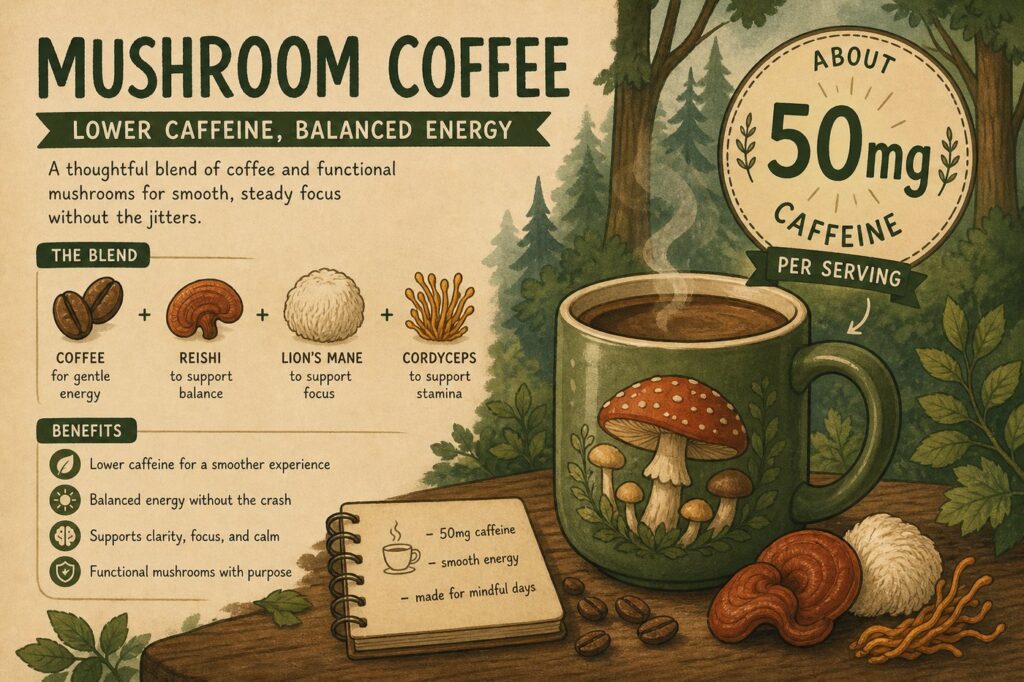
So part of why people feel different might be lower caffeine — not magic mushrooms.
Traditional Chinese and Japanese medicine used these fungi for centuries in teas, tonics, and broths — but not lattes. Coffee for them came later. And, marketing didn’t come until recently.
Still, each mushroom has a distinct story.
Lion’s Mane Coffee — Marketed for Focus
Originally recorded during the Tang Dynasty (618–907 CE) in China, Lion’s Mane in coffee is the “brain mushroom” angle. Lion’s Mane (Hericium erinaceus) stars in focus and creativity marketing — Buddhist monks reportedly used it during meditation for concentration.
What’s the truth on the science? Small human studies on Lion’s Mane and cognition exist — but doses in a coffee cup are often far lower than what researchers used in trials.
Interesting? Yes. Proven in your morning mug? Not yet settled.
Chaga Coffee — Immunity, Antioxidants, and Finnish History
The powerful medicinal fungus Chaga in coffee leans on immune support and antioxidants. Chaga (Inonotus obliquus) is a dark, crusty fungus on birch bark — especially in cold climates.
Test-tube and animal data exist. Human mushroom-coffee trials? Scarce.
Chaga is also the mushroom most tied to real coffee history — not wellness branding. More on historic Finnish Chaga coffee below.
Reishi Mushroom Coffee — Marketed for Stress and Calm
Well known in Japanese and Chinese cultures, the Reishi fungus in mushroom coffee targets calm and stress support. Reishi (Ganoderma lucidum), also called lingzhi, shows up in evening blends and instant sachets designed for a gentler cup.
Reishi has long folk use in East Asia. Modern clinical proof in humans for Reishi in coffee is limited.
Cordyceps Mushroom Coffee — Marketed for Energy
The adaptogen Cordyceps mushroom coffee is the energy play. Cordyceps is the weird one — in the wild, some species infect insects. Although, your coffee almost certainly uses lab-grown extract, vegan and cultivated.
High-caffeine Cordyceps blends pair the mushroom with extra coffee extract for busy mornings or workouts.
Does Mushroom Coffee Actually Work? Benefits vs. Hype
Okay — but do the mushroom coffee benefits hold up?
I’m thinking you might agree: if it works, you want proof — not vibes.

Here’s where it gets messy.
- Lion’s Mane: Some cognition studies exist; coffee-blend doses are often lower than study doses.
- Chaga: Antioxidant data in labs and animals; few rigorous human trials on Chaga coffee.
- Reishi: Centuries of traditional use; limited modern clinical proof in humans for coffee formats.
- Cordyceps: Energy claims; more evidence in sports/extract research than in your specific brand’s cup.
Brands often cite research on mushroom extracts — not on your exact morning brew.
Dose matters.
Extraction method matters.
What survives a hot brew matters.
Bottom line on the science so far:
The mushrooms aren’t made up. The health claims on many coffee bags are often ahead of the evidence. That doesn’t automatically make it snake oil — it means people want coffee plus a story about feeling sharper and calmer. The story sells.
Mushroom Coffee Side Effects and Safety
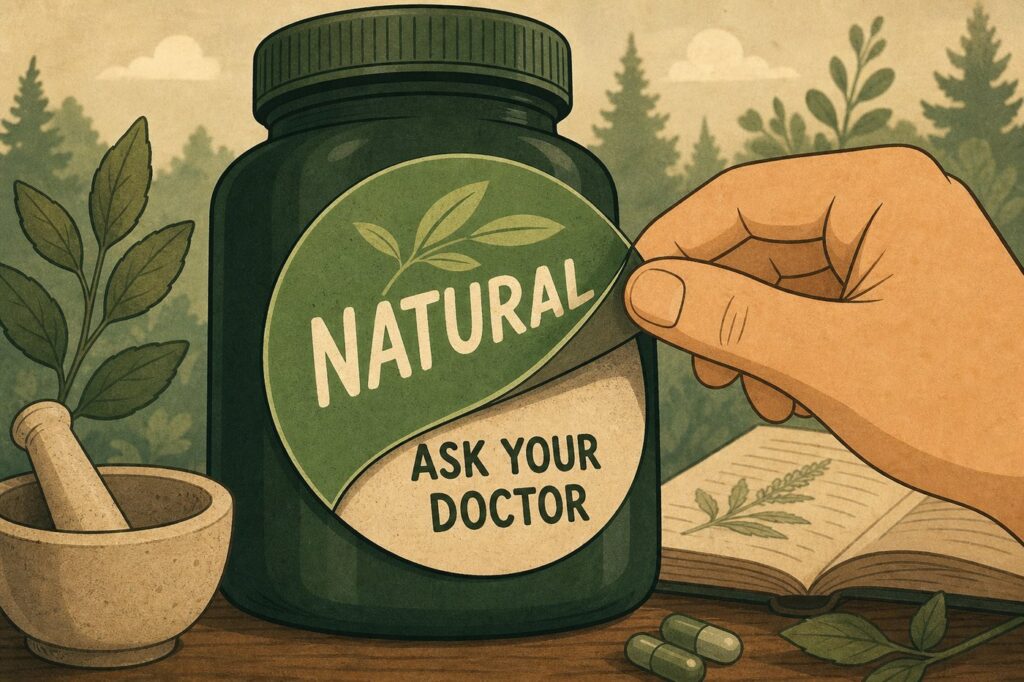
Is mushroom coffee safe? For most healthy adults, yes — when you buy from reputable brands. But mushroom coffee side effects do show up in reviews and medical write-ups.
Common issues: gas, bloating, or stomach upset — especially if you already have a sensitive gut. Caffeine-related jitters or sleep trouble if you drink it late (same as regular coffee, but check the label).
Chaga and blood thinners: Chaga may interact with anticoagulant medication. If you take blood thinners, PLEASE talk to your doctor before drinking Chaga coffee regularly.
Chaga and kidney stones: Chaga is high in oxalates. People prone to kidney stones may want to avoid heavy Chaga use — another reason to read labels and not treat “natural” as risk-free.
Not psychedelic: Medicinal mushroom coffee is not psilocybin. No hallucinations. No trip. It’s adaptogenic coffee — coffee plus functional fungi.
Want another angle on “coffee plus something extra”? Our coffee additives guide covers cinnamon, coconut oil, and more.
Where Mushroom Coffee Really Started: Finland and World War II
So if it’s not a TikTok invention — where did mushroom coffee history really begin?
World War II. Finland. Coffee imports collapsed. Ration cards. Shelves were empty…
For a nation obsessed with coffee, that was a crisis.
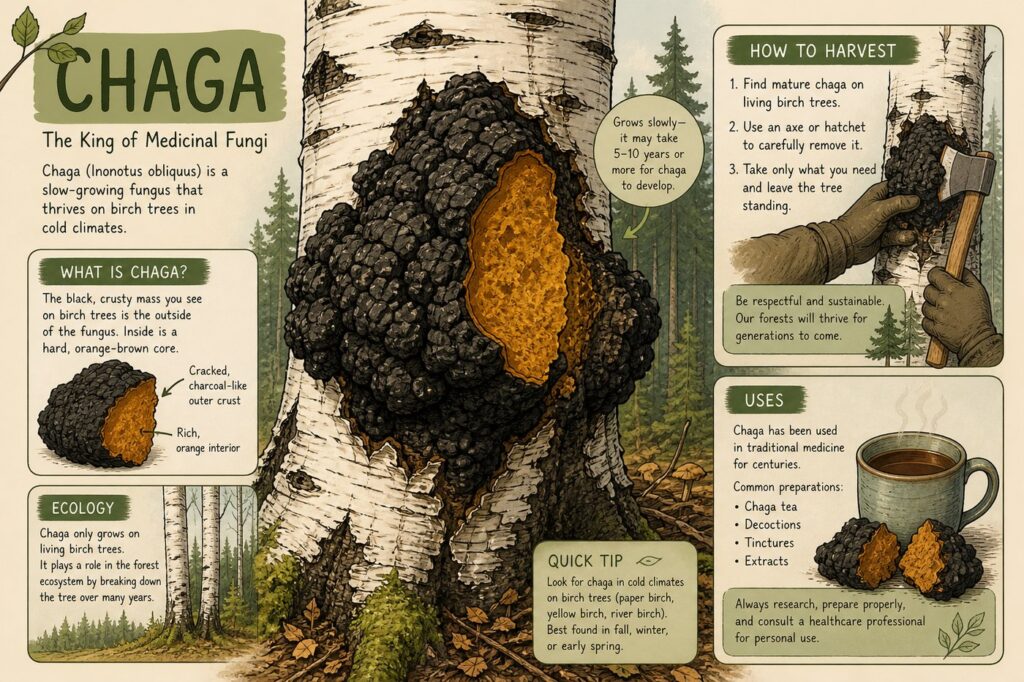
What’s the real story?
Finns foraged Chaga off birch trees. They chipped it, steeped it overnight, pressed it, and drank something dark and bitter the next morning.
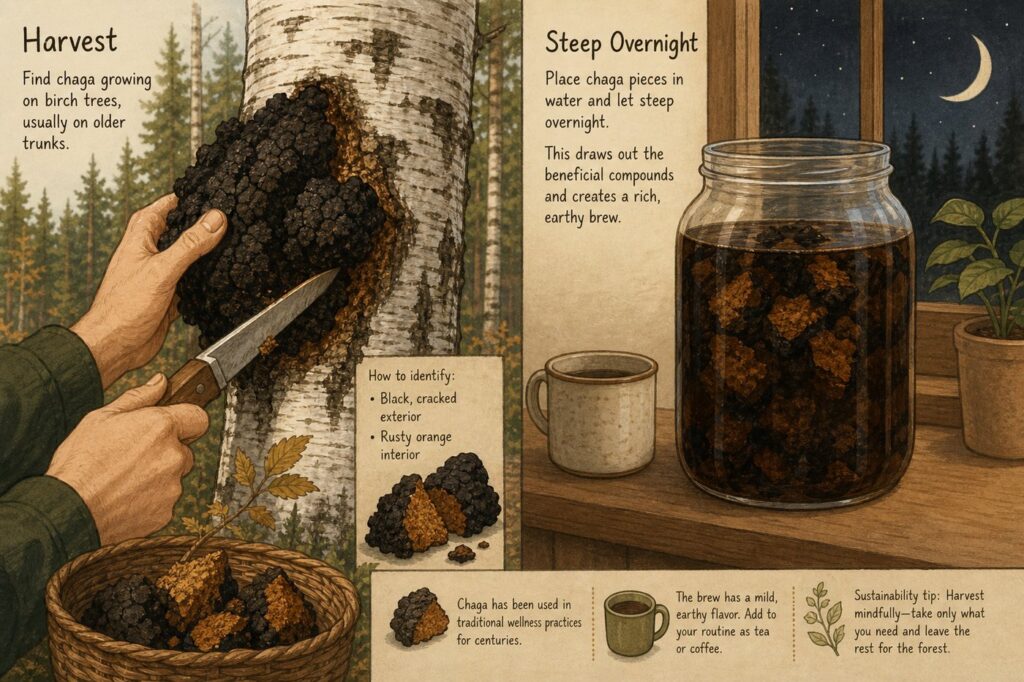
It didn’t taste like Arabica. But it looked like coffee. It felt like ritual.
Fun fact: Chaga’s Finnish name is pakurikääpä. Finns also faked coffee with roasted rye, barley, and even beetroot. Chaga was the mushroom option — a true wartime coffee substitute.
Fast forward to 2012: Finnish founder Tero Isokauppila launches Four Sigmatic and popularizes Chaga extracts globally. He has said his grandparents used Chaga as a coffee substitute — the wartime thread connects directly to today’s wellness aisle.
That history pairs with our Coffee Bean Locations from Around the World hub — how different regions shaped coffee culture, including what people drink when beans run out.
Dancing Goats and the Same Human Impulse
Legend has it goats discovered coffee — dancing after eating coffee cherries.
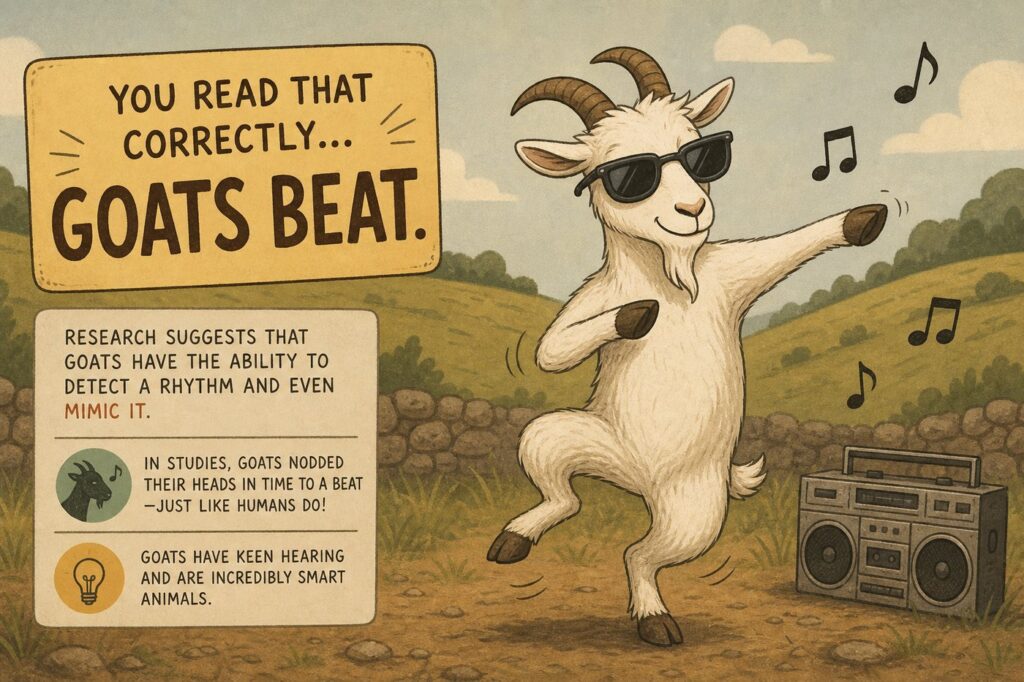
Goats and cherries. Finns and fungus. You and a bag labeled adaptogenic coffee.
Different centuries. Same impulse.
Something in nature. Steeped in hot water.
Hope in a cup.
Mushroom coffee exists because humans refuse to give up the ritual when the beans run out — or when we want more from the beans we already have.
If you care about the bean itself, start with our best medium roast coffee beans or Colombian coffee brands for a classic cup without the mushroom detour.
What to Look for When Buying Mushroom Coffee
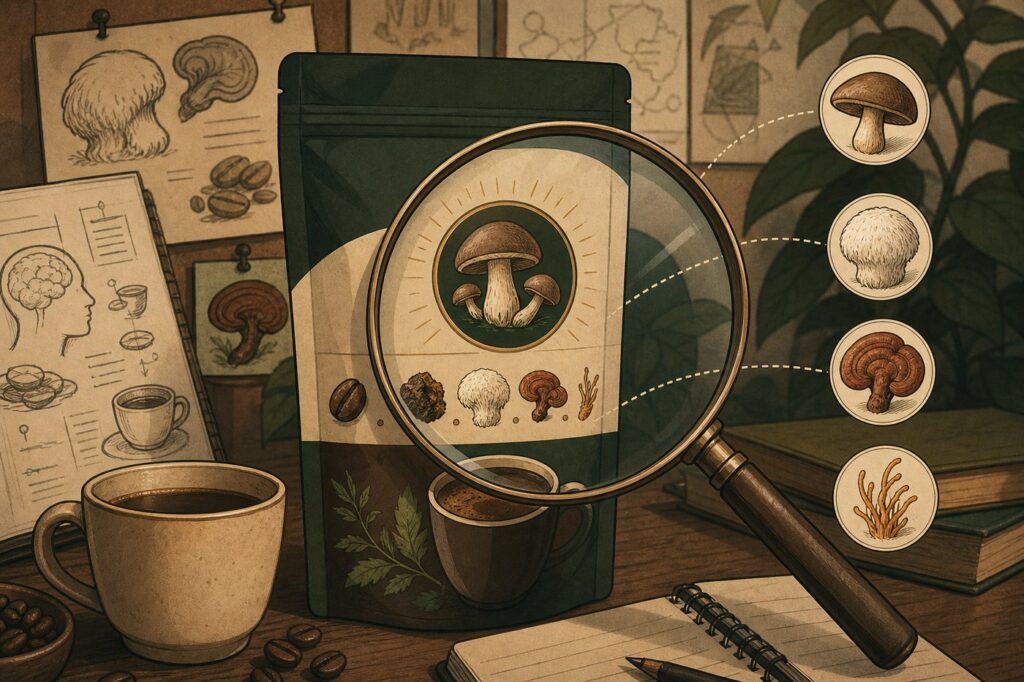
Before you click “add to cart,” here’s what matters on the label.
Fruiting body vs. mycelium. Serious brands use fruiting body extract — the actual mushroom cap and stem. Cheaper blends sometimes pad with mycelium grown on grain (rice or oats), which can mean more starch and less of the compounds marketers hype. If the bag won’t say “fruiting body,” treat the adaptogen claim as decoration.
Dose per cup. Clinical studies often use hundreds to thousands of milligrams per day of a single mushroom. Many coffee bags deliver 100–250 mg of a multi-mushroom blend per serving. Know what you’re paying for.
Ground mushroom coffee vs instant. Ground blends brew like normal coffee in a drip machine or French press. Instant sachets (like our Reishi pick) trade convenience for a different mouthfeel. Match the form to how you actually make coffee.
Mushroom coffee caffeine. “Calm” Reishi blends may still contain caffeine unless labeled decaf. Cordyceps “energy” blends may hit harder than your usual cup. Read the label.
Review authenticity. We run every pick through FakeFind.ai. We skip products with a handful of ratings or suspicious 95%-five-star patterns.
Now — here are picks that passed our checks.
How we chose these products: We compared Amazon listings for review volume, labeled mushroom doses, fruiting-body ingredients where disclosed, and FakeFind.ai authenticity scores. We rejected products with too few reviews or suspicious five-star patterns. We also mixed brands — Longreen for Reishi diversity beyond Four Sigmatic. Verify price and stock before you buy; listings change.
Best Mushroom Coffee on Amazon: Our Picks (June 2026)

We looked for high-quality, well-reviewed options — and mixed brands on purpose (not everything here is Four Sigmatic; think of Longreen as one of the viable Four Sigmatic alternatives for Reishi).
Most blends contain more than one mushroom — so we merged Lion’s Mane and Chaga into one pick (same bag, 20,000+ verified reviews). Reishi and Cordyceps each get their own product because the lead mushroom on the label is different.
| Our pick | Brand | Best for | Form | ASIN |
|---|---|---|---|---|
| Lion’s Mane + Chaga | Four Sigmatic Focus | Focus + immune support | Ground, dark roast | B0756D1D39 |
| Reishi | Longreen 2-in-1 | Calm, Reishi-first cup | Instant sachets (30) | B00ZQZ5XBA |
| Cordyceps | Four Sigmatic Focus Max | High energy + focus | Ground, high caffeine | B09GPYT1BL |
Our Lion’s Mane + Chaga Pick — Four Sigmatic Focus Mushroom Ground Coffee
What’s in the bag: Fair-trade organic Honduran Arabica, dark roast. Per serving (manufacturer): 250 mg organic Lion’s Mane and 250 mg wildcrafted Chaga — both dual-extracted from fruiting bodies, not mycelium on grain. Caffeine lands around a normal cup of coffee (~100 mg per serving — verify on label). USDA Organic, low-acid positioning.

Taste — what buyers actually report: This is the most “just coffee” mushroom coffee on the market. Dark chocolate notes, smooth body, low bitterness compared with many dark roasts. Most people do not taste mushroom in the sip — at most a faint earthy finish that fades fast. Works black, with milk, or in a French press without turning muddy.
Who it’s for: Your first mushroom coffee if you’re skeptical. Your everyday brew if you want Lion’s Mane for focus and Chaga tied to the Finnish history in this article — all in one bag. Drip, pour-over, or French press drinkers who already own a grinder routine.
Who it’s not for: Budget shoppers — it costs more per cup than grocery-store Arabica. High-caffeine seekers (see Focus Max below). Anyone needing a Chaga-only label; this is a dual-mushroom blend.
Brewing tip: Four Sigmatic suggests ~4 tbsp per 12 oz water for drip or press. Adjust to taste — the dark roast is forgiving if you like it stronger.
The honest caveat: 250 mg per mushroom sounds precise, but clinical cognition studies often use much higher daily doses of Lion’s Mane alone. Treat the adaptogens as a bonus on top of good coffee — not a pharmaceutical dose.
Why one pick for two mushrooms? Chaga-only ground coffees with enough real reviews are thin on Amazon. This bag is the most-reviewed mushroom coffee on the market, and Chaga is a named ingredient — not hidden in a “proprietary blend.”
Our Reishi Pick — Longreen 2-in-1 Reishi Coffee
What’s in the box: Thirty single-serve sachets — instant coffee plus Ganoderma lucidum (Reishi) extract. Colombian coffee base. No added sugar in the 2-in-1 formula (unlike many Asian-market 3-in-1 instant coffees that pack creamer and sweetener). Caffeinated, but reviewers often describe it as gentler than a full diner cup.
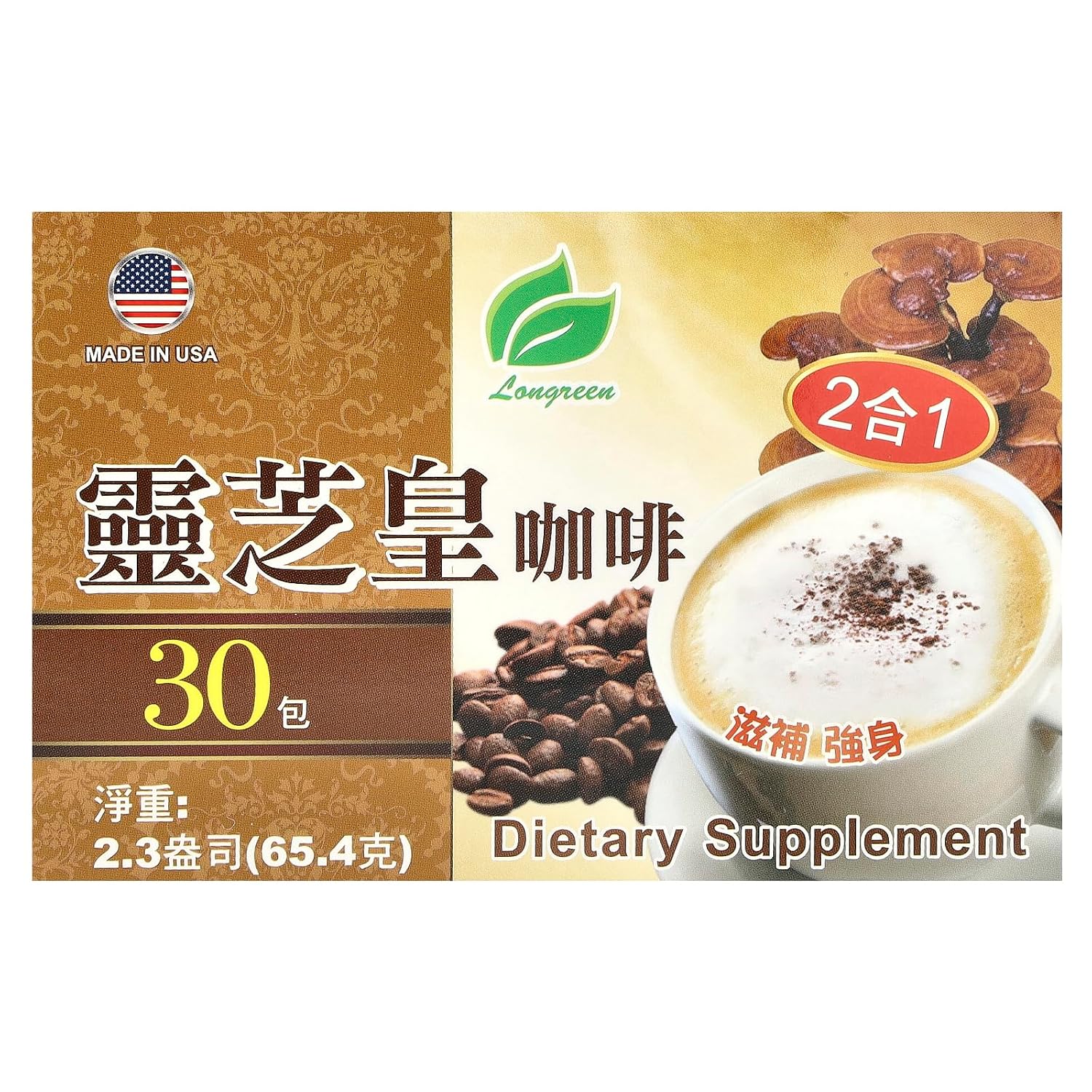
Taste — what buyers actually report: Split verdict, so worth knowing upfront. Fans call it smooth, full-bodied, and closer to “real coffee” than you’d expect from a sachet — mild coffee with a slight herbal aftertaste some find comforting. Critics say it can lean burnt or charred compared with premium instant (think Folgers vs. specialty). Not mushroom-soup territory — Reishi sits in the background. Many people add a splash of milk or an extra half-sachet of regular instant if they want more richness.
SPECIAL SECRET: If your coffee is bitter, one shake of salt gets rid of the bitterness!
Who it’s for: Reishi-first shoppers who want convenience — hotel, office, camping, no grinder. Mid-morning cup when you want calm energy without brewing a pot. Anyone avoiding another Four Sigmatic bag. Longreen has sold Reishi coffee for years; iHerb reviews back up the brand even when Amazon US volume is smaller.
Who it’s not for: French-press purists. Sweet-tooth drinkers who expect latte-level creaminess out of the packet (there isn’t any). Evening-only drinkers who need zero caffeine — this is not decaf.
How to use it: Tear, pour hot water, stir. One sachet per mug. That’s the whole point — speed.
Reishi in plain English: Reishi is the adaptogen marketed for stress balance and wind-down rituals. In this format you’re getting Reishi with coffee, not Reishi instead of coffee — still a caffeinated cup, just often reported as easier on the stomach than harsh diner coffee.
FakeFind.ai checks out on this Amazon product. If Reishi is the adaptogen you care about most, this is the pick that leads with it on the label — and it’s one of the few credible Four Sigmatic alternatives that isn’t another Lion’s Mane clone.
Our Cordyceps Pick — Four Sigmatic Focus Max High Caffeine Cordyceps Coffee
What’s in the bag: Organic dark roast ground coffee built for caffeine — manufacturer cites roughly 180–190 mg caffeine per 12 oz cup (about double a light mushroom blend). Lead functional mushroom: Cordyceps (energy and endurance marketing). Also includes Lion’s Mane and vitamin B12. L-theanine on the label — the same amino acid in green tea, often paired with caffeine to smooth the edge.

Taste — what buyers actually report: Bold dark roast, dark chocolate notes, intentionally not mushroom-forward. Closer to “strong office coffee” than wellness tea. Most reviewers who like it say it tastes like premium dark roast — not Cordyceps soup. Mixed reviews on whether the caffeine feels as high as advertised; some want even more kick, others get jittery. A minority report stomach upset — same as any high-caffeine coffee, worth starting with a half pot if you’re sensitive.
Who it’s for: Mornings when regular coffee isn’t enough. Pre-workout or long drive days. Cordyceps-curious drinkers who still want a real coffee ritual — ground beans in your drip machine or press, not instant sticks.
Who it’s not for: Afternoon or evening drinking (caffeine is the point here). Calm/Reishi seekers — wrong product. Anyone on a tight budget per cup.
Cordyceps in plain English: Marketed for stamina and oxygen utilization — the mushroom athletes name-check. Yours is lab-grown extract in the bag, not wild caterpillar fungus. Pair that with extra caffeine and B12 and you get Four Sigmatic’s “energy” answer, opposite their calmer blends.
Brewing tip: Treat it like regular ground coffee. Don’t under-dose if you want the labeled caffeine — weak brewing dilutes both coffee flavor and the buzz you’re paying for.
The honest caveat: Check the bag for California Prop 65 wording if that matters to you — some Amazon reviewers flag it on supplement-adjacent coffees. Price per cup is premium; you’re paying for Cordyceps + high-caf beans in one SKU.
Is Mushroom Coffee Worth It? Our Verdict
Here’s the deal.
Mushroom coffee exists for two reasons at once:
- History: Finns brewed fungus when coffee disappeared.
- Marketing: We’ll pay extra for focus, calm, and a cleaner caffeine buzz.
You don’t have to pick a side.
- Love coffee and want less caffeine with an earthy twist? Try a small bag.
- Does mushroom coffee taste like coffee? Most blends do — coffee leads, mushrooms sit in the background.
- Want proven brain benefits? The jury’s still out on the mug in your hand.
Do You Want The BEST #1 Mushroom Coffee?
YES - GET IT NOW
My verdict: Mushroom coffee isn’t a scam. It’s a survival drink that got a Silicon Valley rebrand.
And the goats? They’d probably dance either way.
Mushroom Coffee FAQ
What is mushroom coffee?
Regular coffee — ground or instant — blended with powdered extracts from medicinal mushrooms like Lion’s Mane, Chaga, Reishi, or Cordyceps. It is not psychedelic mushroom coffee.
Does mushroom coffee taste like mushrooms?
Usually no — it tastes like coffee with subtle earthy notes. If it has a strong taste of mushrooms or mushroom broth, the blend is probably unbalanced or low quality.
How much caffeine is in mushroom coffee?
It varies. Many blends land around 50 mg per cup — less than a standard ~95 mg drip cup. High-caffeine Cordyceps blends can hit much harder. Always check the label.
What are mushroom coffee side effects?
Most people tolerate it well. Possible issues include bloating, caffeine jitters, and — with Chaga — interactions with blood thinners or concerns for people prone to kidney stones (oxalates). Ask your doctor if you take medication.
What’s the best mushroom coffee on Amazon?
If you’re looking for focus help, we recommend this Chaga coffee: Four Sigmatic Focus (B0756D1D39).
For Reishi-first calm: Longreen 2-in-1 (B00ZQZ5XBA).
For high energy: Four Sigmatic Focus Max (B09GPYT1BL).
We verified all of these for marketing trickery using FakeFind.ai.
What’s the difference between fruiting body and mycelium mushroom coffee?
Fruiting body extract comes from the actual mushroom. Mycelium-on-grain products are often grown on rice or oats and may deliver less of the active compounds you’re paying for. Look for “fruiting body extract” on the label.
Related Articles on The Coffee Bean Menu
- Coffee Bean Locations from Around the World
- Coffee Additives
- Drink Coffee to Lose Weight Fast
- Coffee Good for Depression?
- Best Medium Roast Coffee Beans
- Is Matcha Better Than Coffee? Chemistry, Culture & Honest Verdict
Do You Want a Classic Coffee Bean Without the Mushroom Detour?
YES — SEE OUR TOP COLOMBIAN PICKS
We hope this guide answers what mushroom coffee is, what the benefits and side effects look like, and where to start shopping.
Have you tried a blend you love — or one you’d skip? Hit the comments and tell us what you found.
Editorial note: General information only — not medical advice. Talk to your doctor before trying mushroom coffee if you take medication (especially blood thinners), have kidney concerns, or are pregnant or nursing. Product picks verified with FakeFind.ai (June 2026).
Sorry, the comment form is closed at this time.