When Coffee Replaced Beer at Breakfast (Then Ideas Exploded)
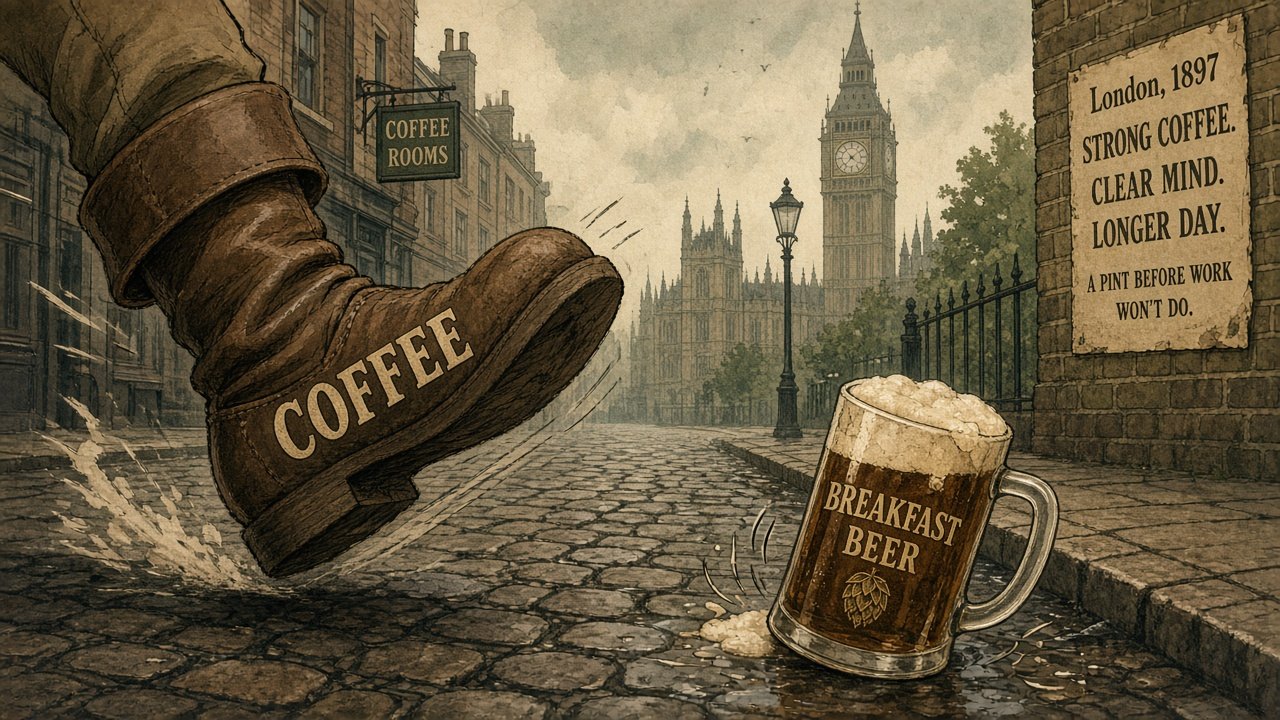
When coffee replaced beer at the European breakfast table, the continent did not invent a new drink so much as change its default setting. For centuries the first cup of the day had been a mild depressant. Then a bitter, boiled import from the Ottoman world started stealing that slot, and the rooms built around it began sorting news, prices, and power.
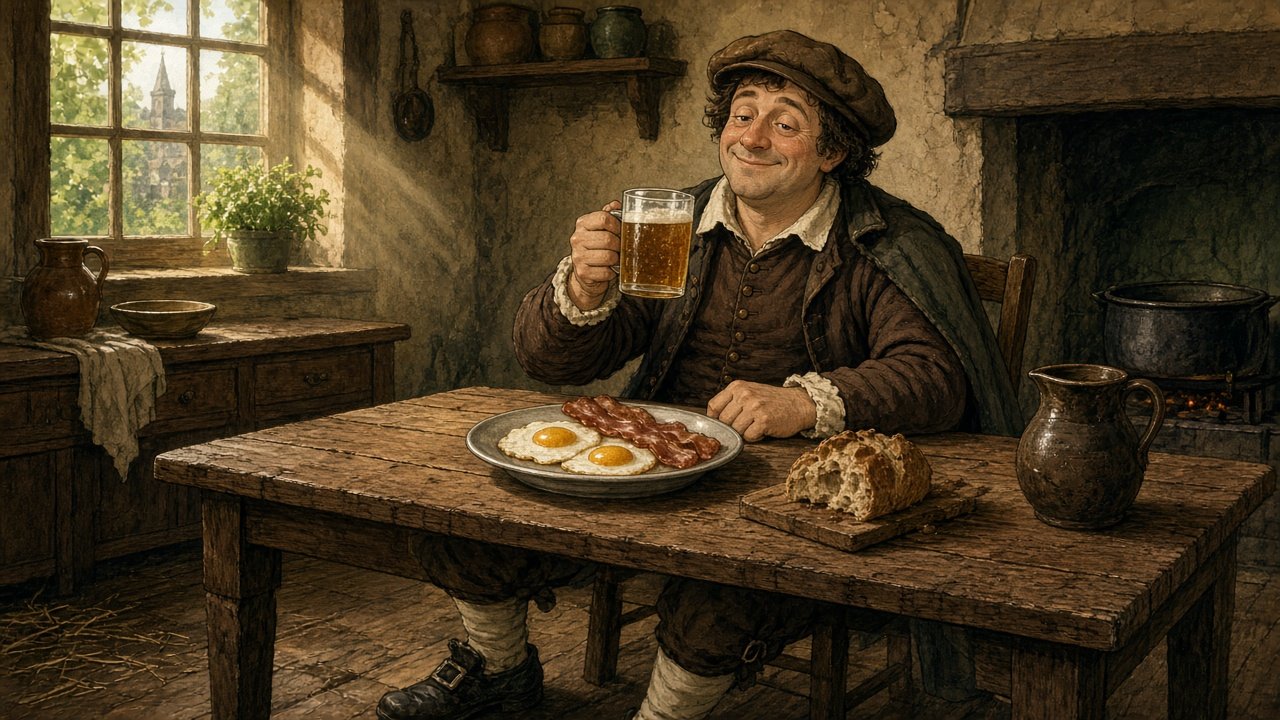
Europeans in the 1600s really did drink beer for breakfast. Not as a pub crawl. Not as a festival. Just as Tuesday. Then Europe got a different kind of buzz.
We traced parish habits, trade ledgers, a smuggler’s own magazine letter, and the coffeehouses that turned into financial markets. One room became an information machine. One man risked his career to steal a plant. And one bill history still has not repaid.
Keep reading for the full story behind the video: small beer mornings, the water myth that overshoots the truth, Gabriel de Clieu’s seedling adventure, how Jonathan’s and Lloyd’s grew out of coffee cups, why coffee did not cause the Enlightenment by itself, and who was locked out of the “penny university” while plantations across the ocean paid for the clarity.
Watch: Coffee Replaced Morning Beer
Prefer the 10-minute cartoon version? The video that pairs with this article is here:
httpv://www.youtube.com/watch?v=skrNPgPQrSs
Breakfast Used to Mean Beer
Picture a normal morning in London, 1652. No last call. No banners. Just breakfast.
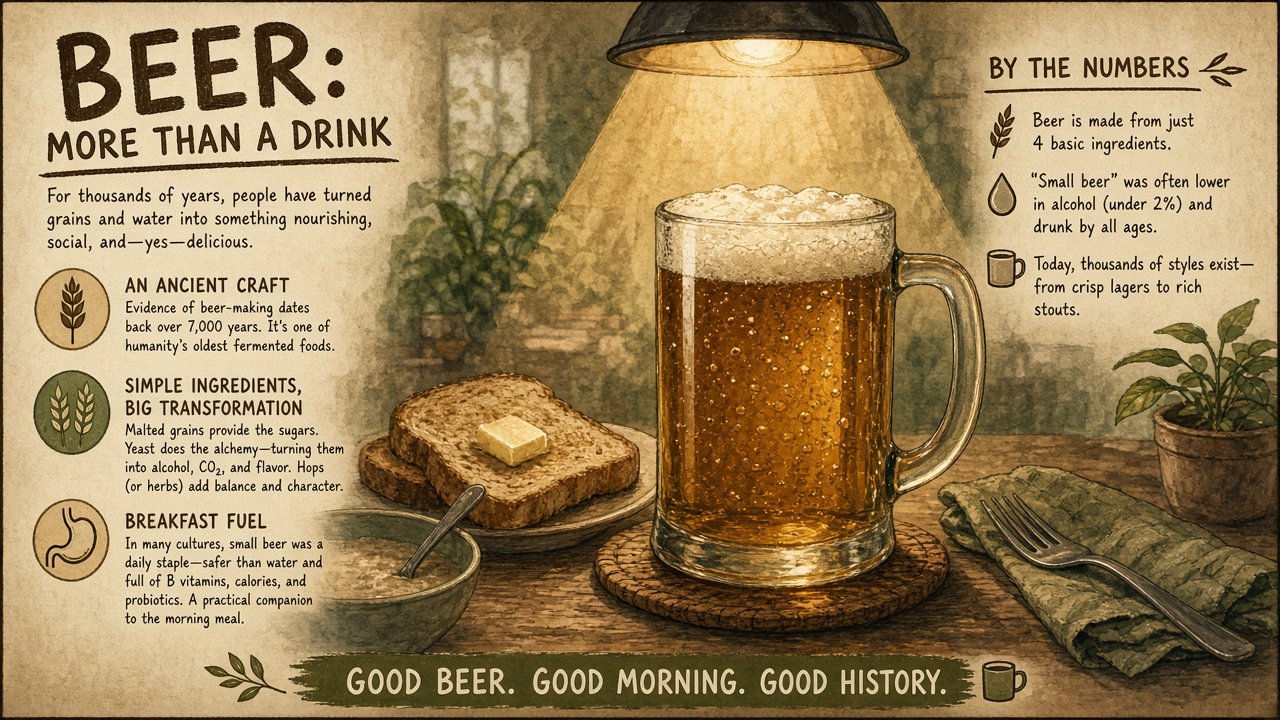
On the table? Beer. Not the heavy stuff you’d chug at midnight. Small beer, also called table beer or small ale, usually sat around one to three percent alcohol. Weak enough that workers drank it. The elderly drank it. Household manuals treated it like bread or firewood: a basic supply.
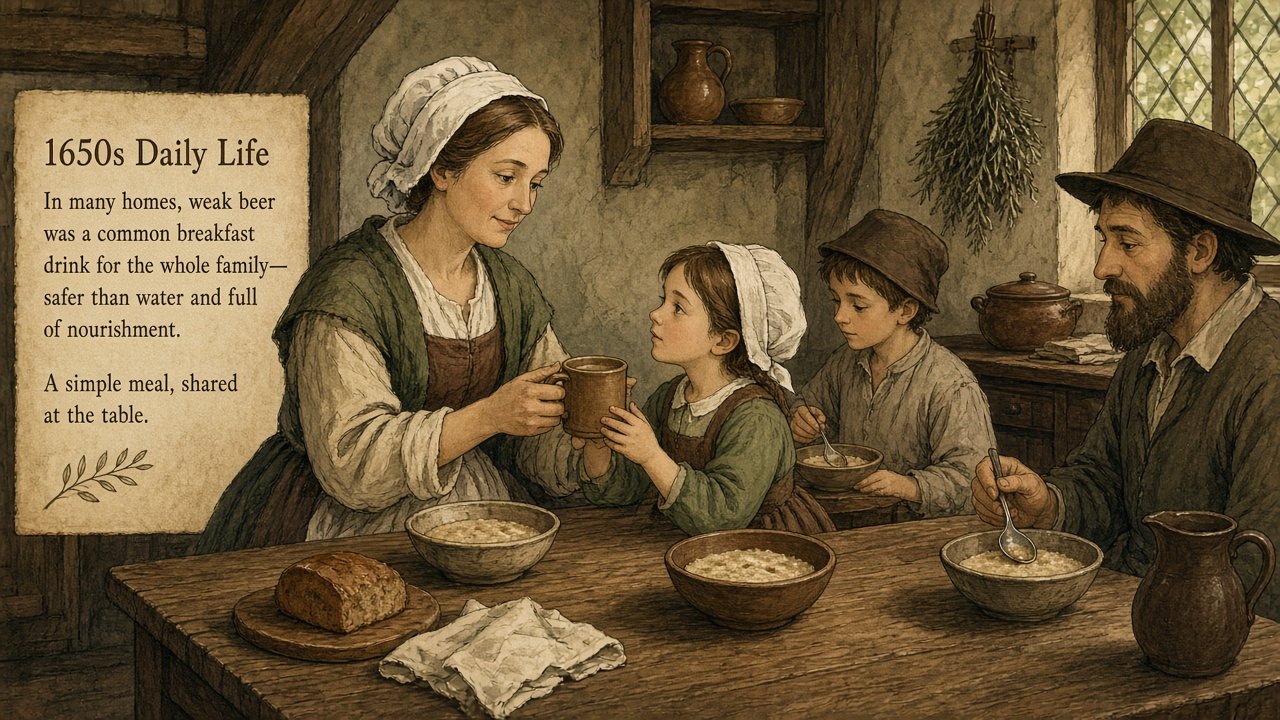
Mothers even gave it to their children. That line lands like a joke until you remember nobody had a second option that felt normal. Small beer sat in the cupboard next to bread and candles. Servants were owed a daily allowance of it. Ships loaded it by the barrel because it traveled, stored, and filled stomachs.
Samuel Pepys mentions drinking habits constantly in his diary, and the wider coffeehouse world he moved through is easy to browse in the Pepys Diary project. The rhythm of the day assumed you’d sip something that dulled the edges, not something that sharpened them.
So Europe ran on a mild depressant. Not drunk. Not slurring speeches. Just a little foggy. A little slow. A little more willing to accept Tuesday as Tuesday. You can’t miss a sharpness you’ve never felt.
The Water Story Is Messier Than the Myth
Here’s the tidy explanation you’ve probably heard: water could kill you, so people drank beer instead. Hold onto that one. The full story is messier, and it’s worth getting right if you care about E-E-A-T more than a viral punchline.

People did drink water. They knew good springs. They maintained wells. Beer was common because it was familiar, nutritious, caloric, and storable, not because every cup of water was a medieval roulette wheel of death. Historians of everyday drink, including Brian Cowan’s work on British coffee culture in The Social Life of Coffee, keep pointing back to habit, calories, and social custom alongside safety.
Still, boiling mattered. Brewing beer meant heating water, and later coffee would use the same trick: kill what made some water dangerous, then skip the alcohol. The chemistry did not care why you drank small beer. All day, every day, a soft fog still sat over a huge share of European mornings.
Popular writers later turned that fog into a grand before-and-after. Tom Standage’s A History of the World in Six Glasses famously framed coffee as “the great soberer,” helping Europe emerge from an alcoholic haze. The metaphor is sticky. The nuance is better: coffee did not invent sober humans. It gave them a safer, sharper alternative that could compete with the first cup of the day.
Then Coffee Rewired the Morning
Then a new drink arrived from the Ottoman world. Dark. Bitter. Boiled like beer. Wired completely differently.
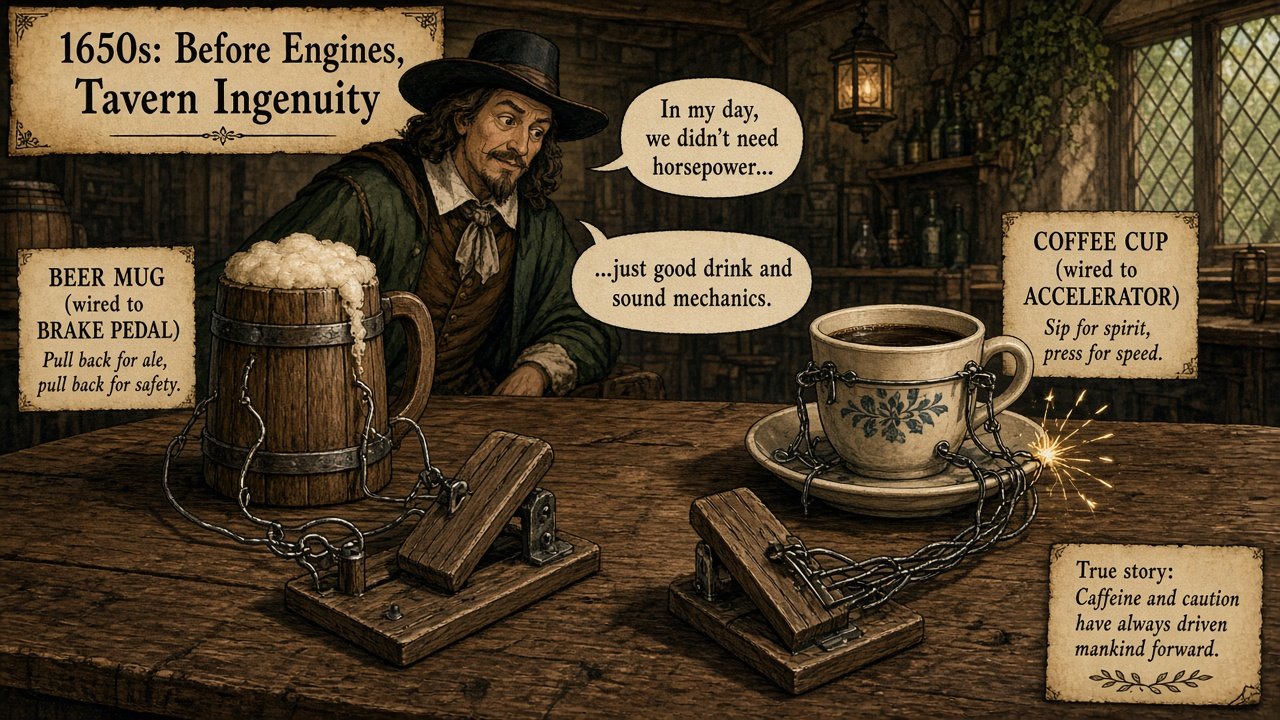
Coffee kept the boil and skipped the alcohol. In its place came the spark, the focus, the clear mind. If you want the modern chemistry behind that feeling, our guide to whether caffeine gives you energy walks through adenosine blocking without the marketing fog.
Europe didn’t just add coffee to the dessert menu. Europe began replacing its first cup of the day. That swap is the hinge of this whole story: same breakfast slot, opposite direction of travel for the brain.
By the late 1600s, London alone had hundreds of coffeehouses. Rulers noticed. We already covered the bans, spies, and drownings in Rulers Killed Coffee Drinkers. It Didn’t Work. This page is the other half of that history: not who tried to crush the cup, but what the cup replaced, and what grew in the rooms that sold it.
The Smuggler Who Shared His Water
By the 1720s, coffee was everywhere in Europe. Growing it was not. The Dutch controlled much of the supply. France had one precious coffee tree worth mentioning, sitting in a Paris greenhouse like a crown jewel under glass.
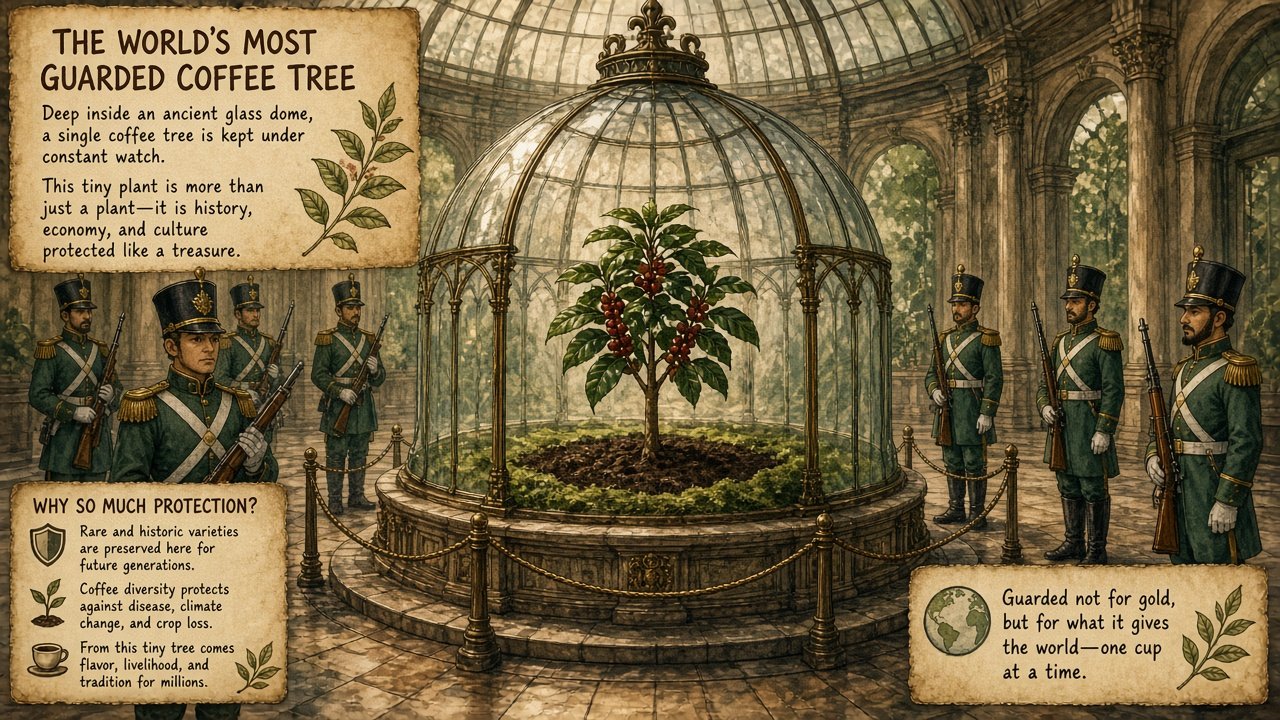
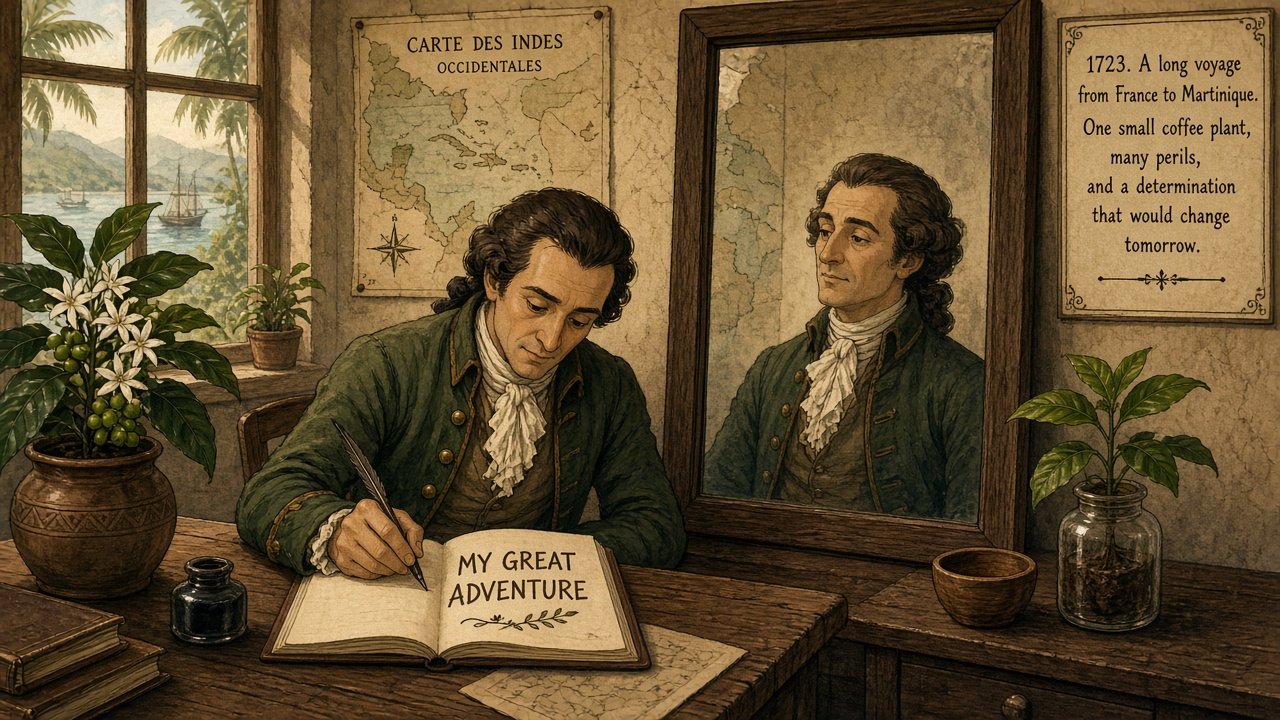
A French naval officer named Gabriel de Clieu wanted that tree. He’d already failed once. He wanted to bring coffee to Martinique, where he had built his life, roughly four thousand miles across the ocean. The king said no.
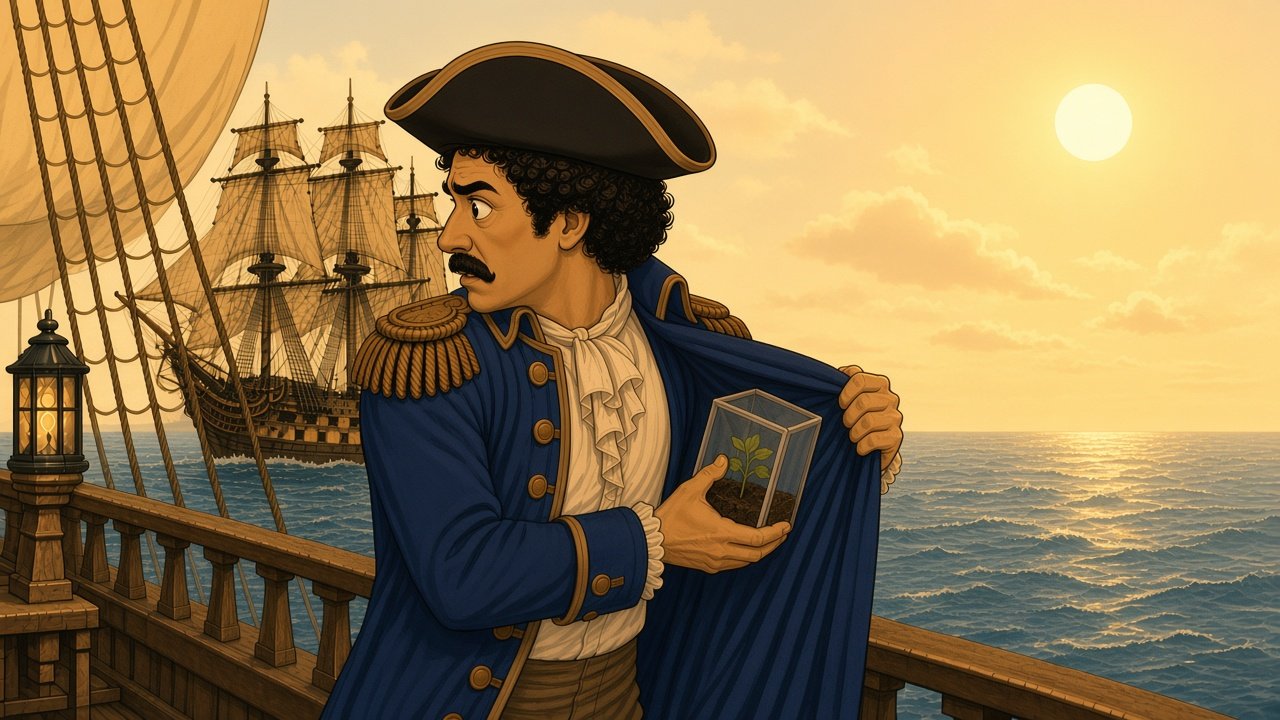
So de Clieu found another way in: friends with access, a doctor willing to make a cutting disappear. In the early 1720s he boarded a ship for the Caribbean with a seedling sealed in a glass box to catch the sun. That should have been the easy part.
A jealous passenger tried to wreck the plant. Pirates intercepted the ship. A storm hit next. Then came dead calm, the doldrums, and a water ration that turned a houseplant into a life-or-death roommate.
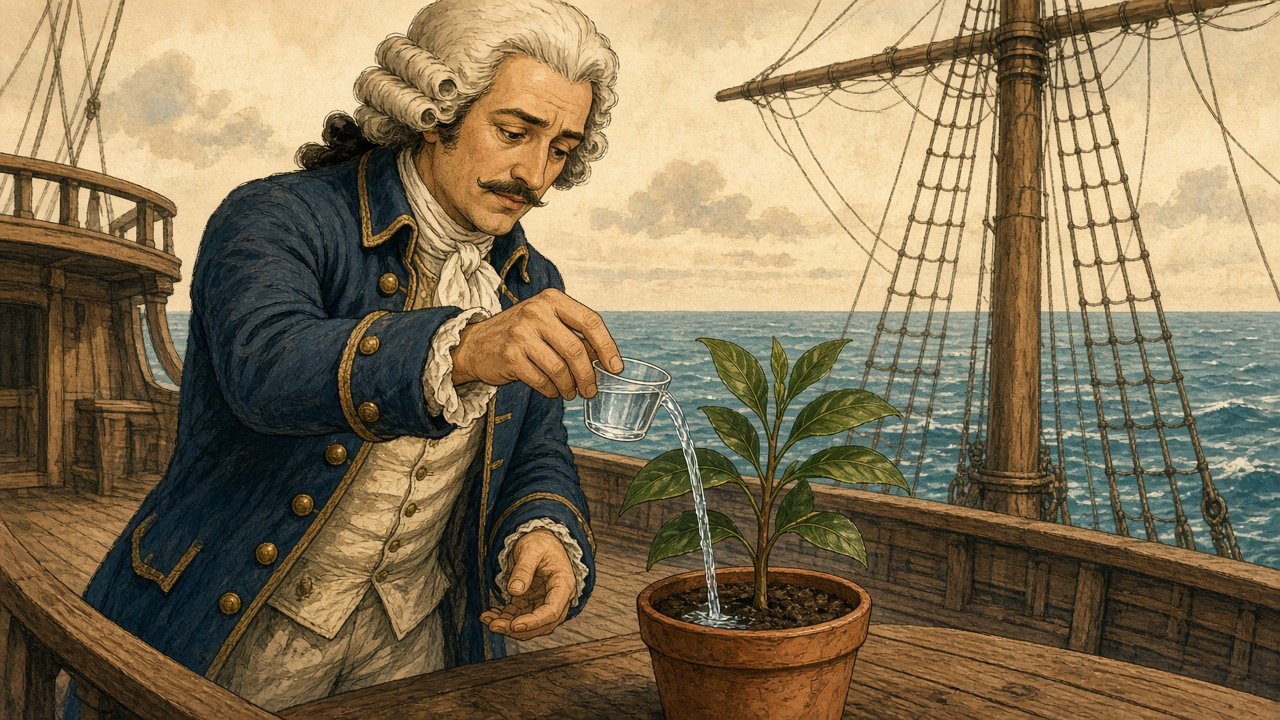
By de Clieu’s own account, published decades later in L’Année littéraire (1774), he shared his drinking water with the plant. An English translation of that letter is available via Flambeaux Tours’ annotated version. The plant lived. It reached Martinique. It was planted, fenced, and guarded. Later writers, including William Ukers in All About Coffee, turned the seedling into a founding myth of New World coffee, complete with the claim that one plant became millions of trees.
He Told the Better Story
Here’s the part the songs leave out. That entire adventure, pirates, storm, water ration and all, comes from exactly one eager source: de Clieu himself, writing about himself more than fifty years later.
Historians have since found something inconvenient. Coffee was already growing in the Western Hemisphere before his ship left the dock, including in French Saint-Domingue and Dutch Suriname. Antony Wild’s Coffee: A Dark History, summarized in standard reference pages such as the Gabriel de Clieu overview, makes the correction plain. De Clieu likely wasn’t the first. He was just the one who told the better story.
That matters for trust. A great narrative can still move a crop, inspire songs, and get a garden named after you. It should not erase the earlier planters, or the later labor system that turned “one seedling” into a world supply chain.
The Coffeehouse Was a Search Engine
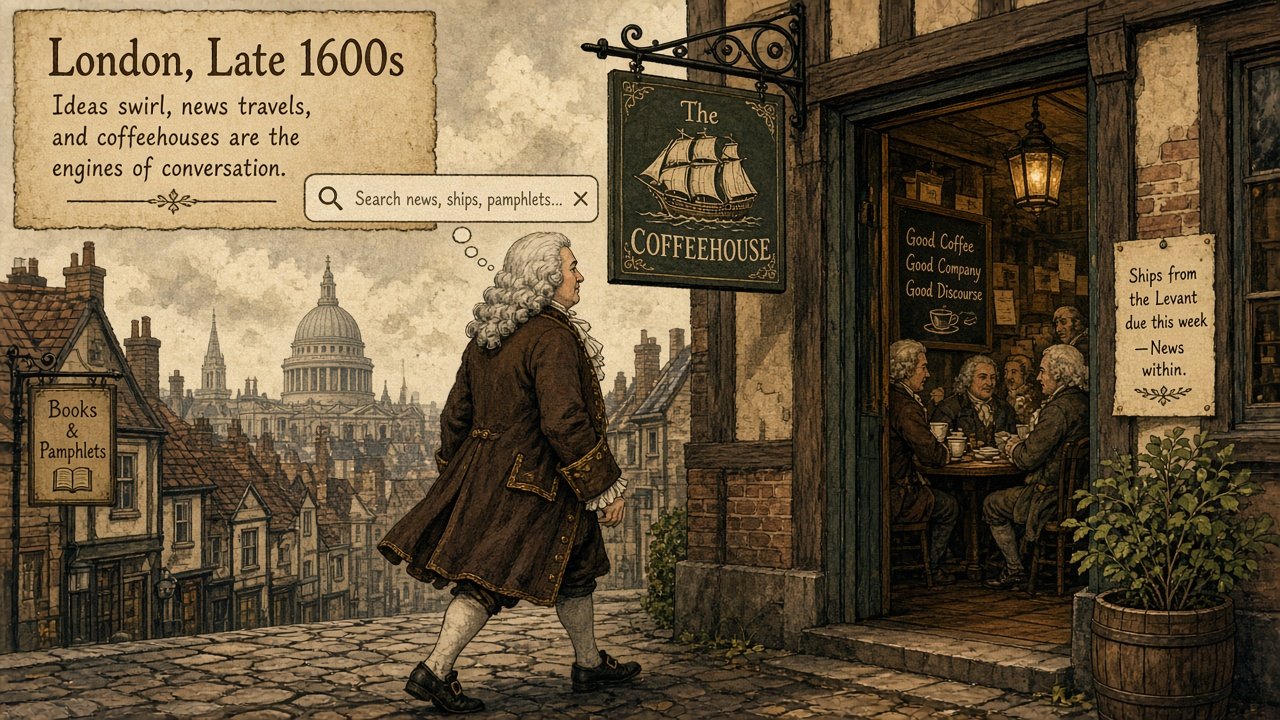
By the late 1600s, London’s coffeehouses were not interchangeable cafes. Each room had a specialty. Will’s filled with poets arguing verse. The Grecian packed scholars. Jonathan’s, in narrow Change Alley, filled with men trading shares. Down by the river, another room crammed with ship owners, captains, and the people who insured their cargo. That last one belonged to Edward Lloyd.
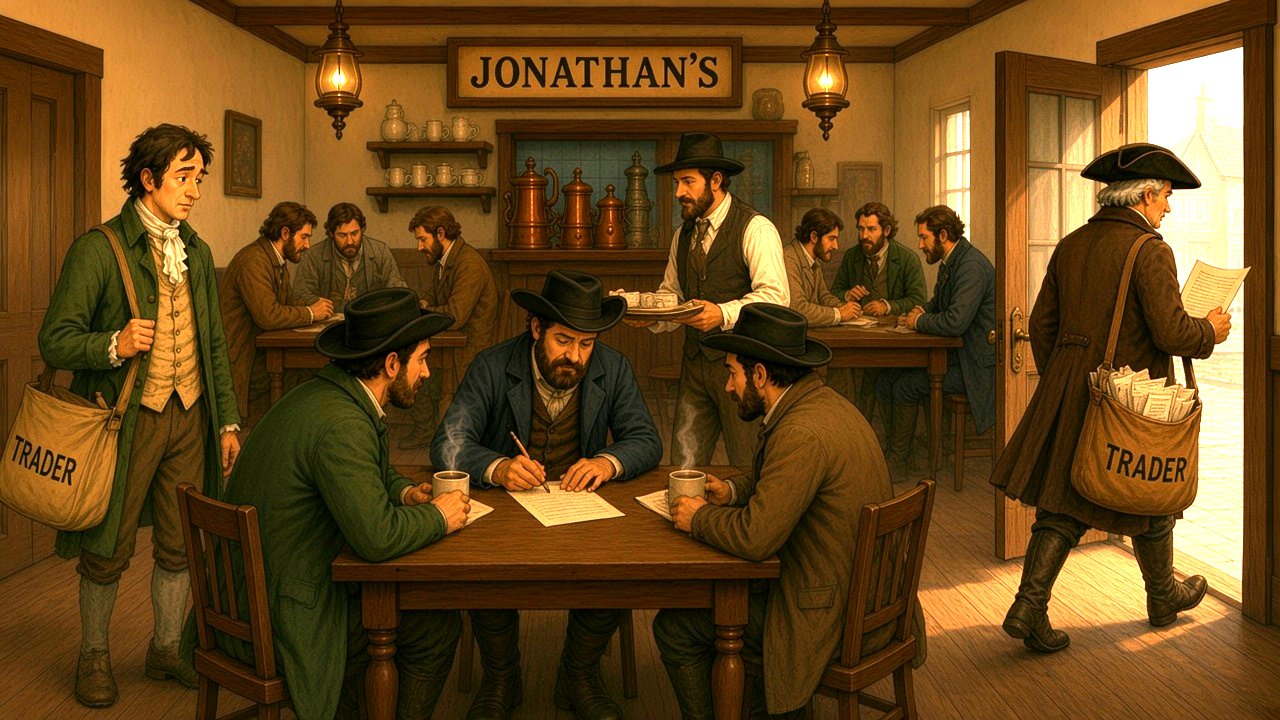
If you needed to know something specific, you didn’t search for it. You went to the correct room. People used their coffeehouse as a mailing address, an inbox a few centuries early. Rooms started writing down what they knew.
From Jonathan’s to the Stock Exchange
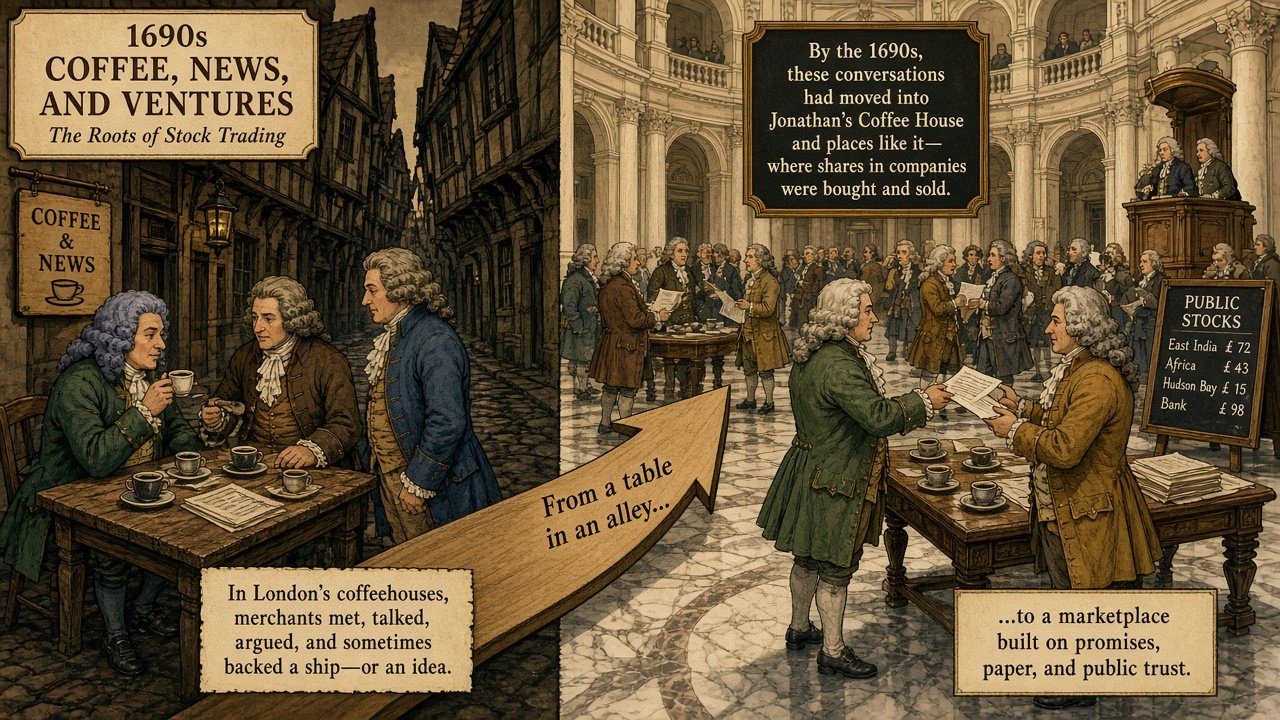
In 1698, a broker named John Castaing began issuing a list of stock and commodity prices out of Jonathan’s. That list, The Course of the Exchange, is the ancestor of every stock quote you’ve ever seen. Historical price datasets still use it; see the ICPSR Course of the Exchange archive.
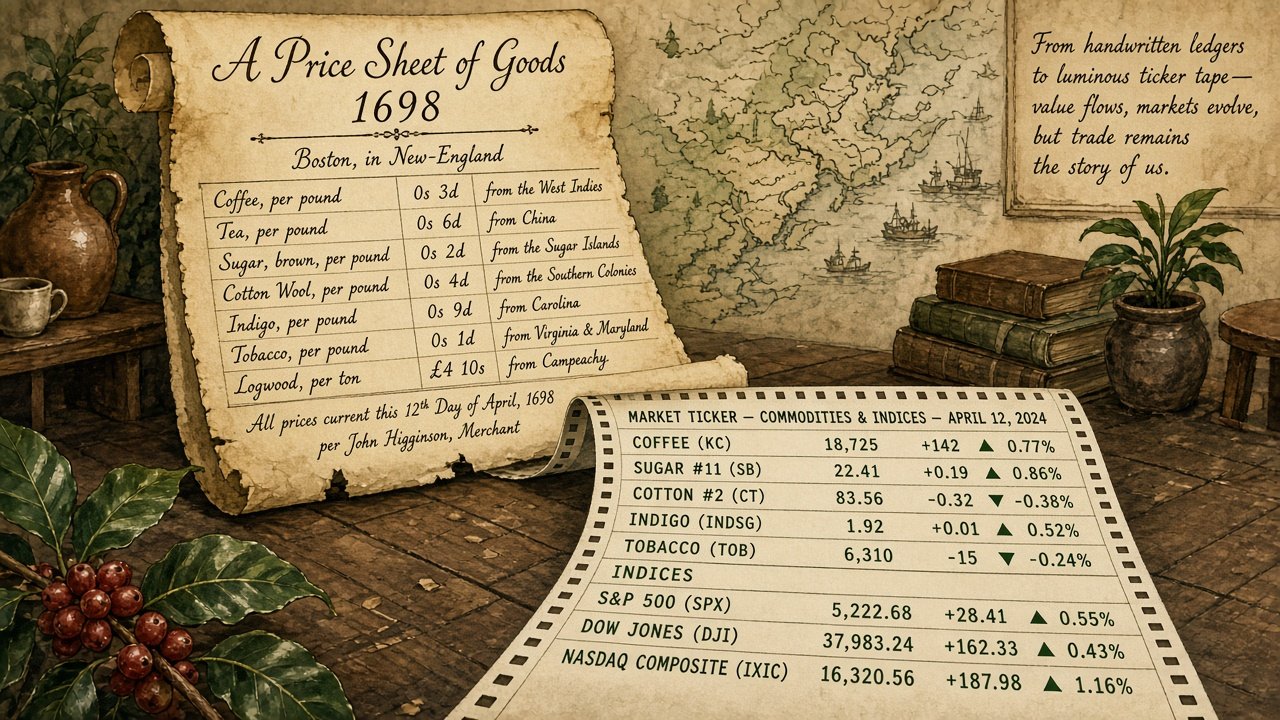
The men trading shares at Jonathan’s weren’t supposed to be trading there. The official exchange didn’t want stockjobbers inside its walls, so the action moved next door into the coffee. Prices got shouted over cups. Rumors got priced in before the palace finished yesterday’s news. That grey market didn’t stay grey. It became the market. Brokers later built “New Jonathan’s,” then the Stock Exchange. A clean popular timeline sits in This is Money’s London Stock Exchange history.
From Lloyd’s Coffee House to Global Insurance
Meanwhile, at Lloyd’s, sailors and merchants came for the coffee and stayed for the news: which ships sailed, which arrived, and which sank. Lloyd printed a shipping sheet out of his own coffeehouse. That paper, and that room, became Lloyd’s of London. The market’s own history page still starts with Edward Lloyd’s coffee shop by the Thames.
Look at the list again. A stock exchange. An insurance market. Both still carry the names of the coffeehouses that birthed them, because neither one was really founded in a boardroom. They evolved from communal morning coffee into powerhouse financial institutions.
The Woman Who Kept the Price List Alive
Here’s a fascinating detail the adventure films usually skip. John Castaing’s price sheet did not die with the men shouting around the table. For decades in the 1700s, control of The Course of the Exchange passed through family hands that included Arabella Castaing Jackson Wharton, whose name rarely appeared in the imprint even while she helped keep one of London’s core financial publications stable.
Rare-book and economic-history notes on the paper, including discussions collected around surviving Course of the Exchange issues, underline how unusual that continuity was. A woman helped steward the ancestor of the stock quote while the coffeehouse rooms themselves still treated debate as a largely male sport. The market was modernizing faster than the door policy.
That contrast is not a cute trivia card. It shows how information machines can outgrow the social rules of the rooms that invented them.
Did Coffee Cause the Enlightenment?
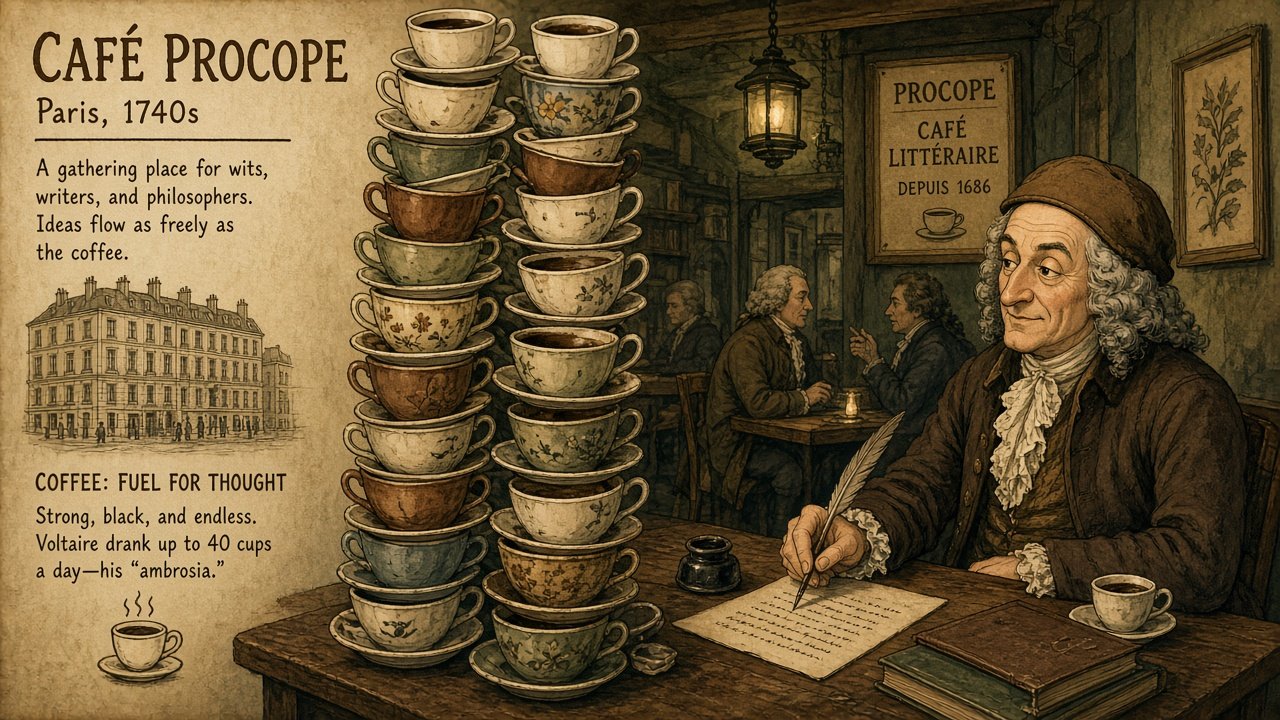
Coffee didn’t stay in London. Paris had its own version. In 1686, Café Procope opened near the Comédie-Française. Voltaire reportedly drank absurd stacks of cups there. Diderot worked on the Encyclopédie a few tables over. This wasn’t only England’s brokerage story. This was Enlightenment philosophy being argued over coffee.
So here’s the big question. Did switching from beer to coffee trigger the Enlightenment?
Remember the water myth from the beginning. Coffeehouses didn’t start in London or even in Paris. They started in the Ottoman world, in cities like Cairo and Istanbul, generations before Europe got the buzz. If coffee alone guided enlightened thinking, that’s where the story should have started. It didn’t.
What actually changed in Europe was timing. Printing presses were already spreading ideas faster than ever. Trade was dragging the world into European ports. Old institutions were losing their grip. Britannica’s overview of the Enlightenment puts reason, science, and politics at the center, with coffeehouses as one venue among newspapers and salons. Coffee didn’t hand Europe the Enlightenment. It showed up at the same moment Europe needed to stay awake for it.
One thing the tidy version leaves out: England did not sober up.
England Did Not Sober Up: The Gin Craze Split the Day
While mornings were switching toward coffee, London spent the early-to-mid 1700s in the Gin Craze, one of the worst stretches of mass drunkenness in its history. The day wasn’t getting clearer. It was being split in half: sharp in the morning, wrecked by night.
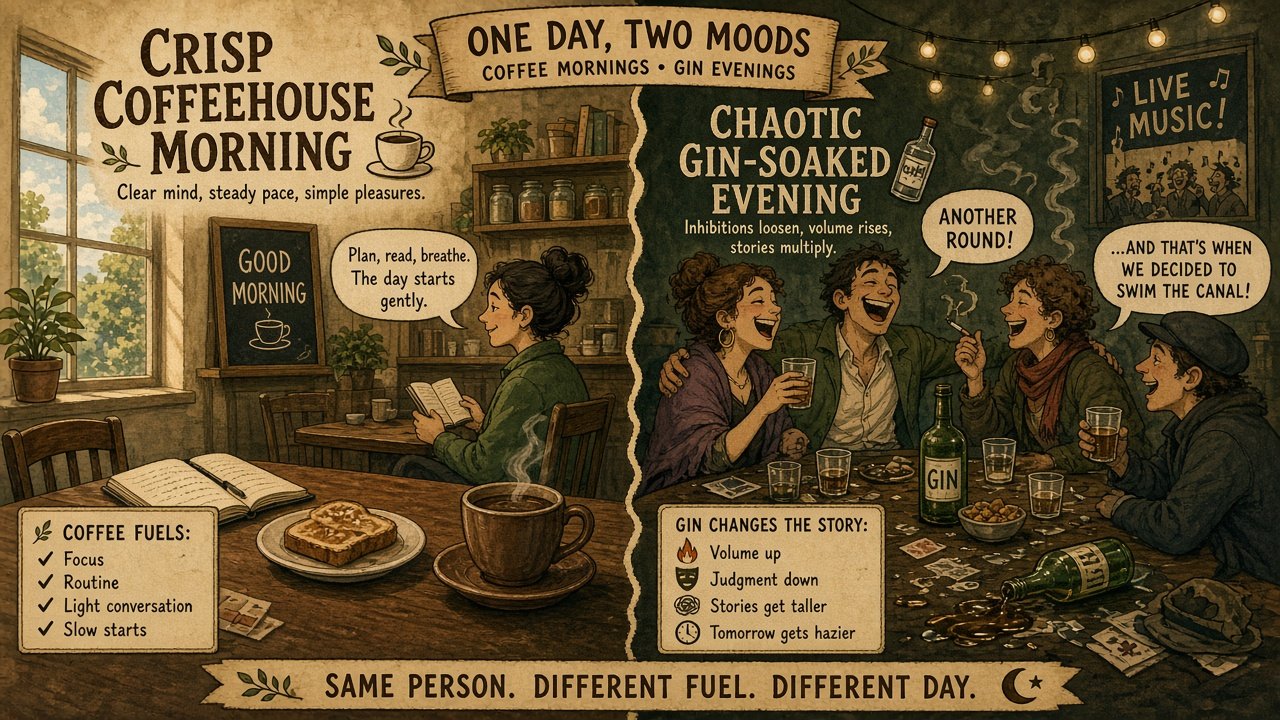
Parliament tried again and again to tax and license “strong waters.” The History of Parliament’s Gin Acts summary tracks the mess: thousands of retailers, cheap spirits outrunning beer duties, and a 1751 crackdown that finally helped consumption fall. Brian Cowan notes that by the 1720s coffee had been normalized in Britain just as tea and gin surged as competitors in The Social Life of Coffee.
So no, coffee did not bring on the Enlightenment like a light switch. It did keep the lights on in specialist rooms while everything else caught fire, including the gin shop around the corner.
The Bill Nobody Mentions
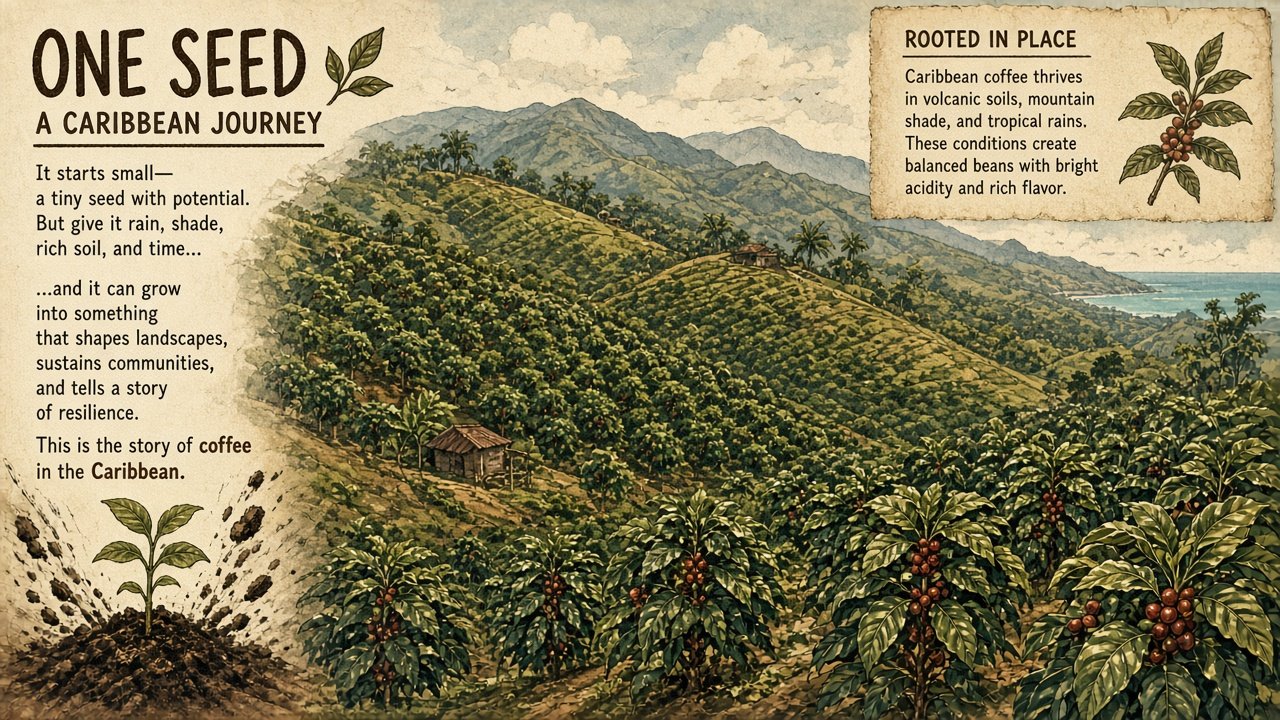
Remember de Clieu, the man who got songs for sharing his water with a plant. That plant didn’t stay a houseplant. It became a worldwide supply chain.
By the late 1780s, the French colony of Saint-Domingue (today’s Haiti) was producing roughly half to about sixty percent of the world’s coffee, according to commodity-chain research such as this Slavery & Abolition study of slave-based coffee. It did that with enslaved labor, under conditions that killed people at a horrifying rate.
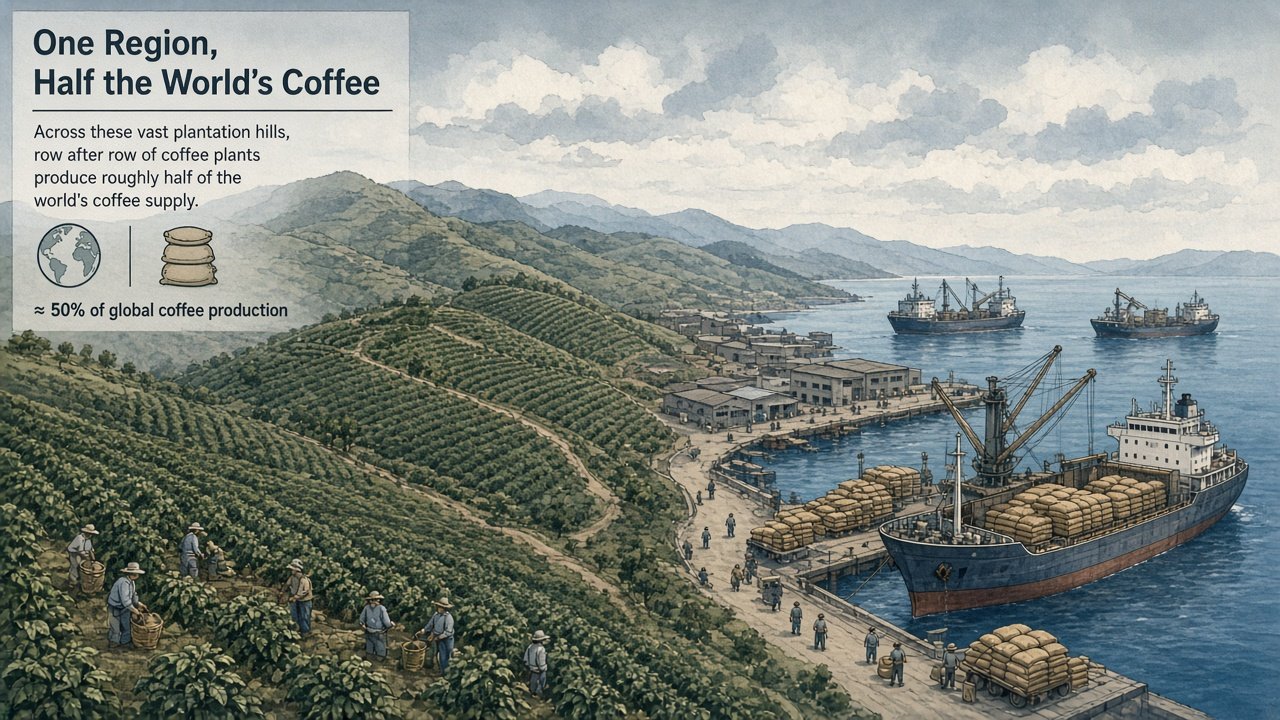
So the clear-headed European morning, the penny cup, and the room full of men arguing about liberty, equality, and reason were all running on a plantation system across an ocean. Some of the people writing about universal rights were drinking the product of that exact system as they wrote. That’s not a footnote to this story. It is the story.
Lloyd’s own history page now states plainly that Britain’s shipping industry transported millions of enslaved African people, and that Lloyd’s was a global center for insuring that industry. Clarity in the coffeehouse and violence in the supply chain were not separate timelines. They were the same trade.
Who Got a Seat at the Penny University
The rooms themselves had a door policy. European coffeehouses were overwhelmingly male spaces for debate. Women worked in them. Some even owned them. Equal voices in the argument were another matter.
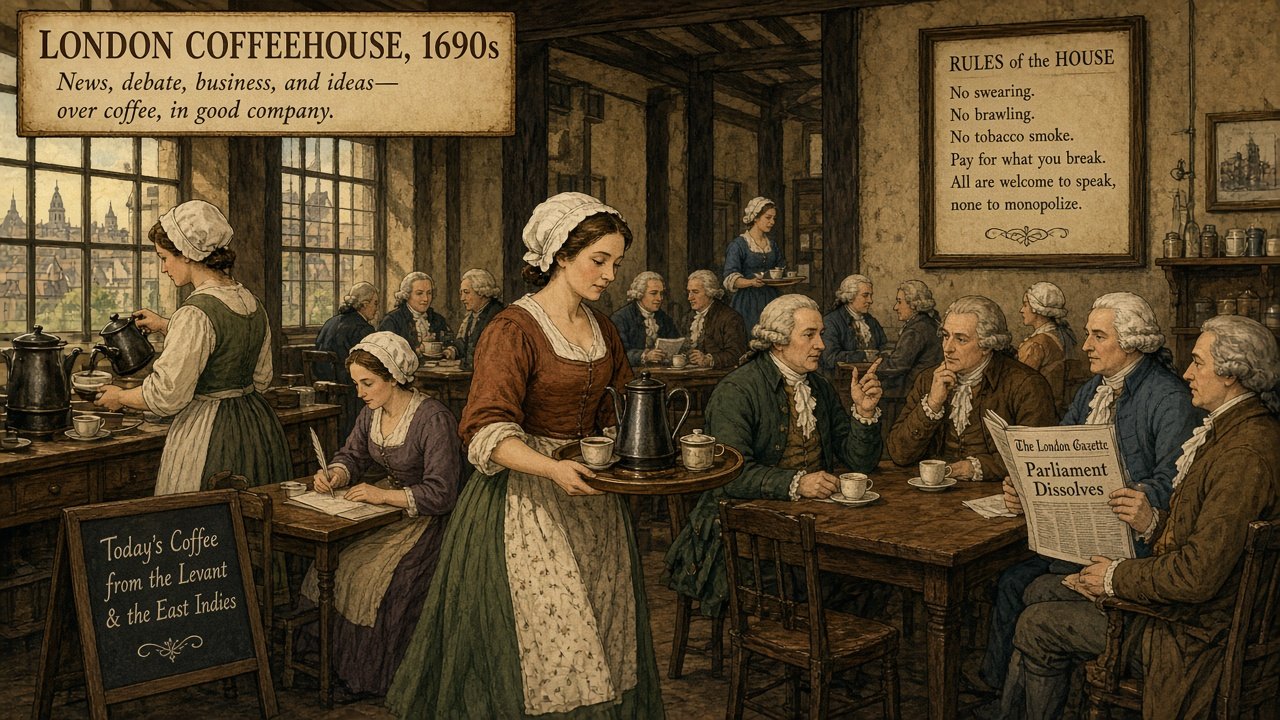
“Penny university” sounded open: any man with a coin. Closed to women with a coin and their own opinion. The satirical 1674 Women’s Petition Against Coffee, held by the British Library, mocked husbands who vanished into coffeehouses all day. Historians still argue how literally to read the pamphlet, but the gender anxiety around those rooms was real enough to print.
De Clieu got a statue. The people who actually grew what supported these famous rooms were forgotten by the same histories that memorized his water ration.
How Coffeehouses Became Institutions
If you want the arc in one glance, here is how the breakfast swap turned into durable power:
| Room / Claim | What Started There | What It Became | Honest Limit |
|---|---|---|---|
| Household breakfast | Small beer as daily supply | Coffee as the sharper first cup | Water was not always deadly; habit and calories mattered too |
| Jonathan’s Coffee House | Castaing’s price lists (1698) | Roots of the London Stock Exchange | Traders were pushed out of the official exchange first |
| Lloyd’s Coffee House | Shipping news and marine talk | Lloyd’s of London insurance market | Also insured the slave-trade shipping system |
| Café Procope | Philosophers arguing over cups | Enlightenment cafe legend | Coffee alone did not cause the Enlightenment |
| Saint-Domingue plantations | Enslaved labor growing coffee | Roughly half the world’s coffee by the late 1780s | The unpaid bill behind European “clarity” |
Frequently Asked Questions
Did Europeans really drink beer for breakfast?
Yes, especially weak small beer or table beer. It was a household staple for adults and often for children, closer to pantry inventory than to a night out. Strength was low, but the daily dose still left a soft fog over the morning.
Was beer only drunk because water was unsafe?
No. Contaminated water was a real danger in many places, and boiling helped. People still drank known good water, and beer also won on calories, storage, taste, and custom. The pure “water was poison, beer saved everyone” line is too neat.
Did Gabriel de Clieu invent New World coffee?
He helped spread coffee in the French Caribbean and wrote the most famous seedling adventure. Coffee was already growing in parts of the Americas before his voyage. Treat him as a dramatic distributor with a self-authored legend, not the sole origin point.
Did coffee cause the Enlightenment?
No single drink did. Coffeehouses made excellent rooms for news, argument, and dealmaking while print culture, trade, and politics were already shifting. Ottoman coffeehouses existed long before Europe’s Enlightenment, which is the simplest proof that beans alone do not invent an intellectual movement.
Europe Changed Its Default Setting
We started with beer at breakfast. Not a party. Survival, or something close to it. Then a man risked his career, and rationed his own drinking water, to move a single plant across an ocean. That plant fed a coffee network that exploded worldwide. Specialist rooms sorted people by what they knew. Conversation turned into price sheets. Repeated meetings hardened into institutions still standing today.
Those same rooms also excluded people, and they drew power from an exploited global supply chain still priced into bags you can buy today. Coffee did not wake an entire continent with one sip. The drink helped Europe reorganize what wakefulness was for.
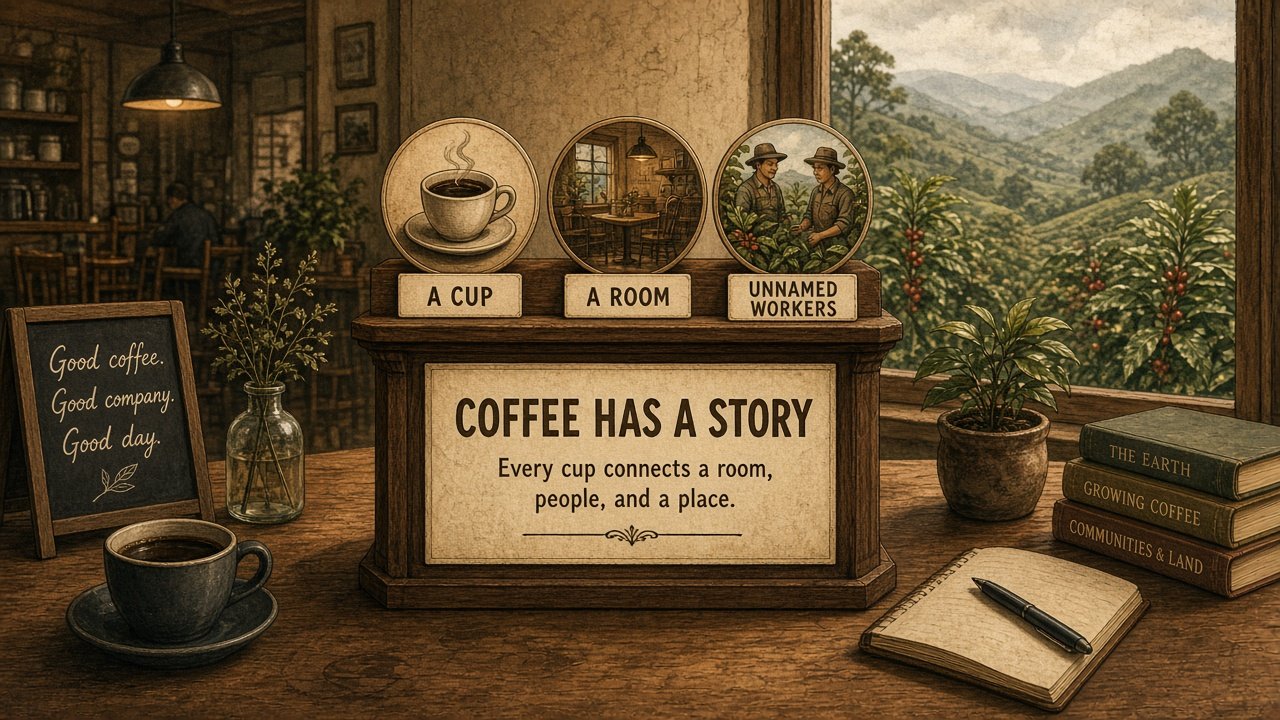
So what actually built the modern world: the drug in the cup, the room built around it, or the people who paid for both and never got the credit? Tell us which one you land on.
If you want the ban-and-rebellion sequel, start with why rulers killed coffee drinkers. For the chemistry inside the morning swap, read does caffeine give you energy. And if you’re curious how later generations hacked the cup when beans ran short, our mushroom coffee guide is a strange, useful detour.
Sorry, the comment form is closed at this time.